The Quiet Coast
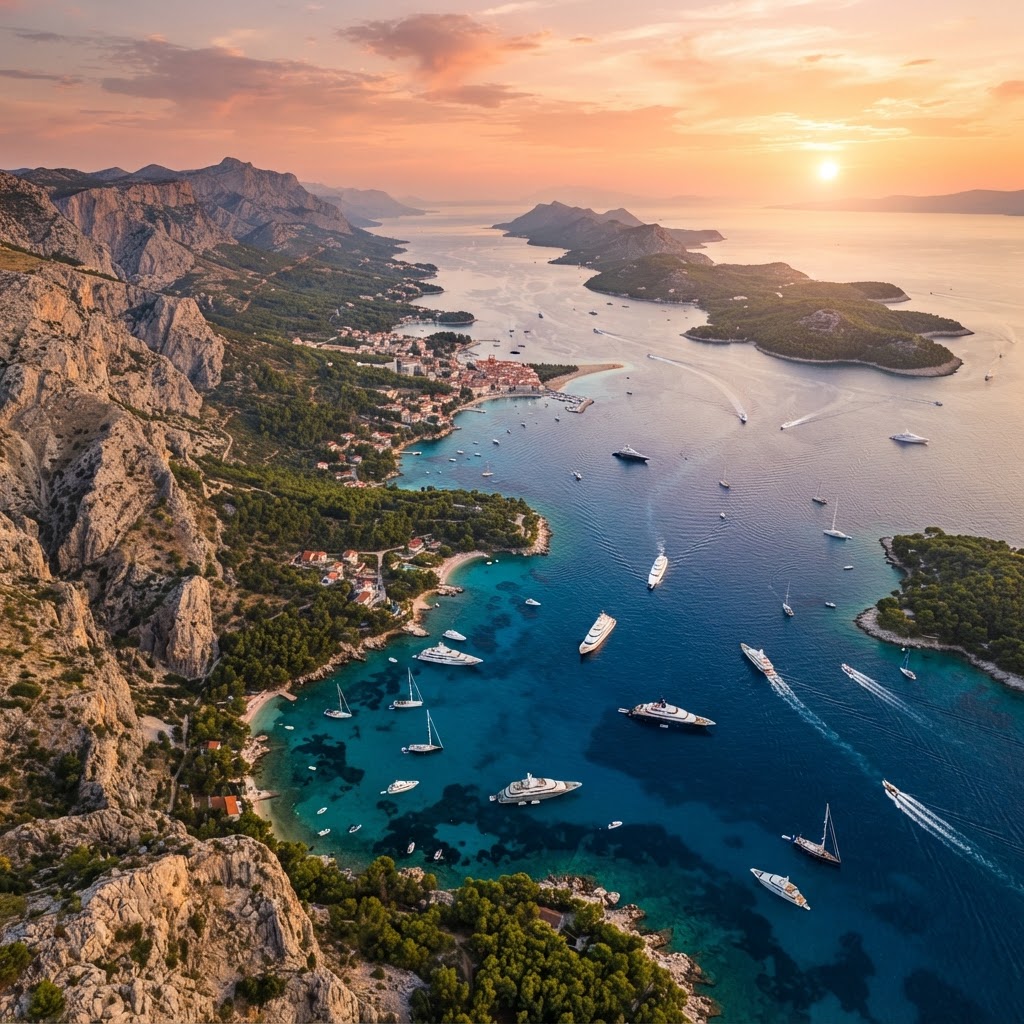
There is a stretch of the Adriatic, roughly from Dubrovnik north to Split, where the mountains drop directly into the sea in a way that reminds you of Norway — except the water here is warmer than the air in most northern summers, and the stone is limestone, pale and luminous in the afternoon light, and the scent as you sail close to shore is pine and wild rosemary rather than fjord and glacier.
This is Croatia's Dalmatian coast, and it represents one of the finest cruising grounds in the Mediterranean — a chain of more than a thousand islands stretching along a shoreline that has been inhabited, fortified, and fought over for three millennia.

Dubrovnik and the Elaphiti Islands
Begin in Dubrovnik, whose walls rise from the Adriatic with a theatricality that still astonishes, even in an age of image saturation. The Old Town is a UNESCO World Heritage site for good reason: its marble streets, Baroque churches, and Renaissance palaces constitute one of the most perfectly preserved medieval cities in the world. But the smart sailor doesn't linger long in Dubrovnik — the islands are calling.
The Elaphiti archipelago, immediately northwest of the city, offers Kolocep, Lopud, and Sipan — three islands of pine forest and quiet coves where the water is so clear you can count the pebbles on the bottom at forty feet. Anchor off Lopud's Sunj beach for an afternoon swim, then dine aboard as the sun drops behind the island's monastery-topped hill.
Hvar and the Pakleni Islands
Further north, Hvar has acquired a reputation for glamour — and in July and August, the waterfront does indeed fill with superyachts and the evenings hum with possibility. But the real pleasure of Hvar lies in the Pakleni Islands, a short tender ride from Hvar Town, where a series of limestone islets offer some of the finest swimming in the Adriatic. The water here is a particular colour — not blue, not green, but something between the two, with the clarity of glass.

The Kornati Archipelago
The Kornati Islands represent the Adriatic at its most elemental: a national park of nearly ninety islands, mostly uninhabited, where the limestone has been sculpted by wind and water into extraordinary formations. There are no towns here, no restaurants, no beach clubs — only stone and sea and silence, and the occasional shepherd tending a small flock on an island that has been in his family for centuries.
When to Go
June and September are the months for the Adriatic. The water is warm, the winds are reliable, and the summer crowds have either not yet arrived or already departed. The meltemi, which blows hard through the Aegean in high summer, does not reach these waters, making for gentler sailing and more comfortable anchorages.
Split and the Diocletian Legacy
No Adriatic itinerary is complete without Split. The city has grown up inside and around the ruins of Diocletian's Palace, built by the Roman emperor as his retirement residence in 305 AD. Unlike most Roman ruins, which stand apart from the life around them, Diocletian's Palace is woven into the fabric of the city: cafes occupy its courtyards, apartments fill its upper floors, and the ancient stone is worn smooth by the passage of seventeen centuries of footsteps. To arrive by sea, as Diocletian himself might have done, is to understand why he chose this place — the mountains behind, the islands before, the light on the water unlike anywhere else in the Mediterranean.