The Discipline of the Edge
There is a particular kind of architecture that only appears at the water's edge. It is not the architecture of the city, where buildings define the street, nor of the countryside, where the house is an object in a field. It is an architecture of negotiation — between shelter and exposure, between the desire to look out and the need to hold one's ground against wind, salt and storm. The very best waterside houses are not designed to dominate their setting but to dissolve into it, so that the eye cannot easily tell where the built form ends and the landscape begins.
What is striking is how differently this negotiation is carried out in the north and the south of Europe. The Nordic coast and the Mediterranean demand opposite responses — opposite materials, opposite geometries, opposite relationships to the sun — and yet the underlying principle is the same. A house that breathes with its environment is, almost by definition, a house that has been designed for one place and no other.
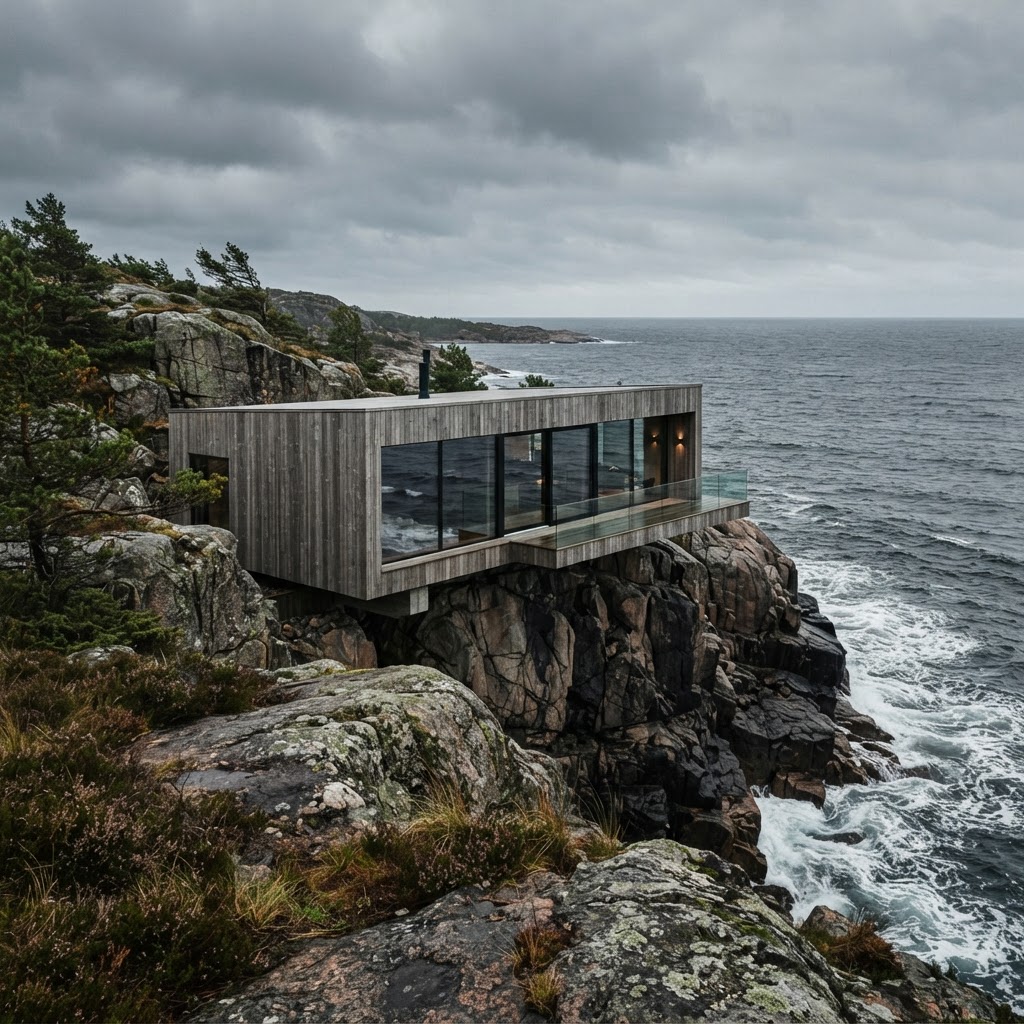
The Northern Sublime
On the Scandinavian coast, the sea is not an invitation but a force. The shoreline is granite, the wind is constant, the light is low for much of the year and theatrical for a few short months. The houses that succeed here are not the ones that defy the climate but the ones that are shaped by it.
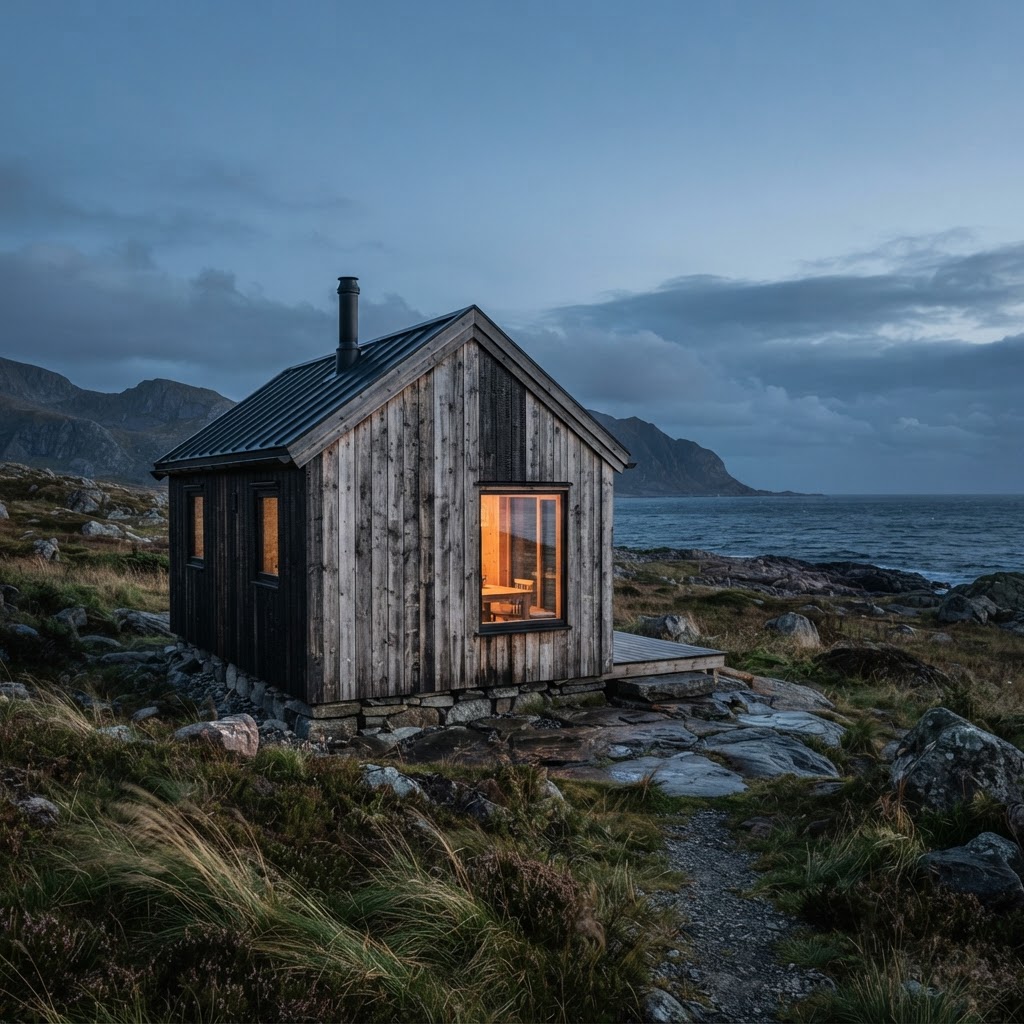
The defining gesture of Nordic coastal architecture is the slow acceptance of weather. Timber — the region's defining material — is left untreated, so that it silvers and greys over the years until it becomes almost indistinguishable from the rock it sits on. Vertical cladding mimics the standing trunks of the boreal forest; pitched roofs shed snow; deep overhangs protect the timber from driven rain. Nothing is painted to impress. The house is allowed to age, and in ageing it becomes part of the coast.
The Norwegian practice Snøhetta has built a series of cabins and observation houses along the country's fjords and headlands that embody this philosophy. Their forms are often deliberately simple — a single wedge, a small gable, a low pavilion — because in a landscape as dramatic as Norway, architecture that competes with the scenery merely loses. The point is not to be noticed but to frame: to give the occupant a precise, deliberate opening onto the water while the rest of the building recedes into the rock.
What these houses understand is that the northern coast asks for compression. Interiors are small, warm and focused, oriented around a single window or hearth, so that the wildness outside is held at exactly the right distance. The architecture is a kind of lens, concentrating the vastness of the sea into something a person can bear to look at.
The Discipline of Light
If the north is about shelter, the south is about light. The Mediterranean coast presents the opposite problem: not too little sun, but too much. A house on a Greek island that is not designed around the sun becomes uninhabitable by July. And so the architecture of the southern coast has evolved over centuries into one of the most elegant responses to climate anywhere in the world.
The whitewashed houses of the Cyclades are the clearest example. Their form is not a matter of taste but of function. White walls reflect the sun's heat. Thick stone — the material the islands are made of — provides thermal mass, absorbing heat through the day and releasing it slowly through the cool night. Small windows cut the glare. Flat roofs collect what little rain falls. And the whole composition is terraced into the hillside, so that the roof of one house becomes the terrace of the one above it, and the village reads from the sea as a single pale cascade rather than a collection of separate buildings.
The Greek island tradition of building "without architects" produced, over centuries, an architecture of extraordinary refinement. The cubist forms that so captivated Le Corbusier were not designed to be beautiful; they were designed to be cool, to be built from the rubble of the site, and to turn their backs on the meltemi — the fierce summer wind that scours the Aegean. Beauty was a by-product of necessity.
Contemporary Mediterranean architects working in this tradition tend to do something paradoxical: they build less, not more. The best new houses on the coast of Mallorca, Cap Ferrat or the Aegean are often distinguished by what is absent — no grand gesture, no conspicuous entrance, no obvious façade. Instead, the house is dug into the slope, its living spaces opening onto a single seaward terrace, its roof planted with native grasses so that from above it disappears into the hillside entirely. The architecture is almost an act of disappearance.
Materials of the Place
The common thread, north and south, is a refusal to import materials. A Nordic coastal house built of concrete and glass feels wrong, not because those materials are inherently bad, but because they do not belong to that shore. A Cycladic house rendered in northern timber feels equally alien. Great waterside architecture is, almost without exception, made of the place it stands in.
This is not nostalgia. Local materials behave correctly in local conditions. Scandinavian timber moves with the humidity, swelling and shrinking seasonally without cracking. Mediterranean stone stays cool in the midday heat. Dry-stone walls — the ancient terraces that climb the hillsides of the Aegean, the Amalfi coast and the Dalmatian islands — are built without mortar, so that wind passes through them rather than pushing them over. A dry-stone wall that has stood for two centuries will outlast a concrete one built beside it.
The most thoughtful contemporary architects treat the site itself as a quarry. They map the existing stone walls, the prevailing wind, the angle of the summer sun at three o'clock in the afternoon, the path the rain takes down the slope. The house is then designed as a response to that map, so that to remove it would leave a gap not just in the view but in the logic of the landscape.
The Indoor-Outdoor Threshold
The other shared principle, across both latitudes, is the treatment of the threshold. The best waterside houses are not organised around a clear distinction between inside and outside; they are organised around a gradient. You move from the fully enclosed interior, to a sheltered loggia, to an open terrace, to the sea — and at no point do you pass through a hard boundary.
In the north, this gradient is defensive. A deep porch, a windbreak wall, a south-facing courtyard: each is a way of staging the transition from warmth to weather, so that stepping outside is not a shock. In the south, the same gradient is sensual. A shaded portico gives onto a terrace that gives onto a pool that gives onto the sea, and the architecture's job is to make each step feel inevitable.
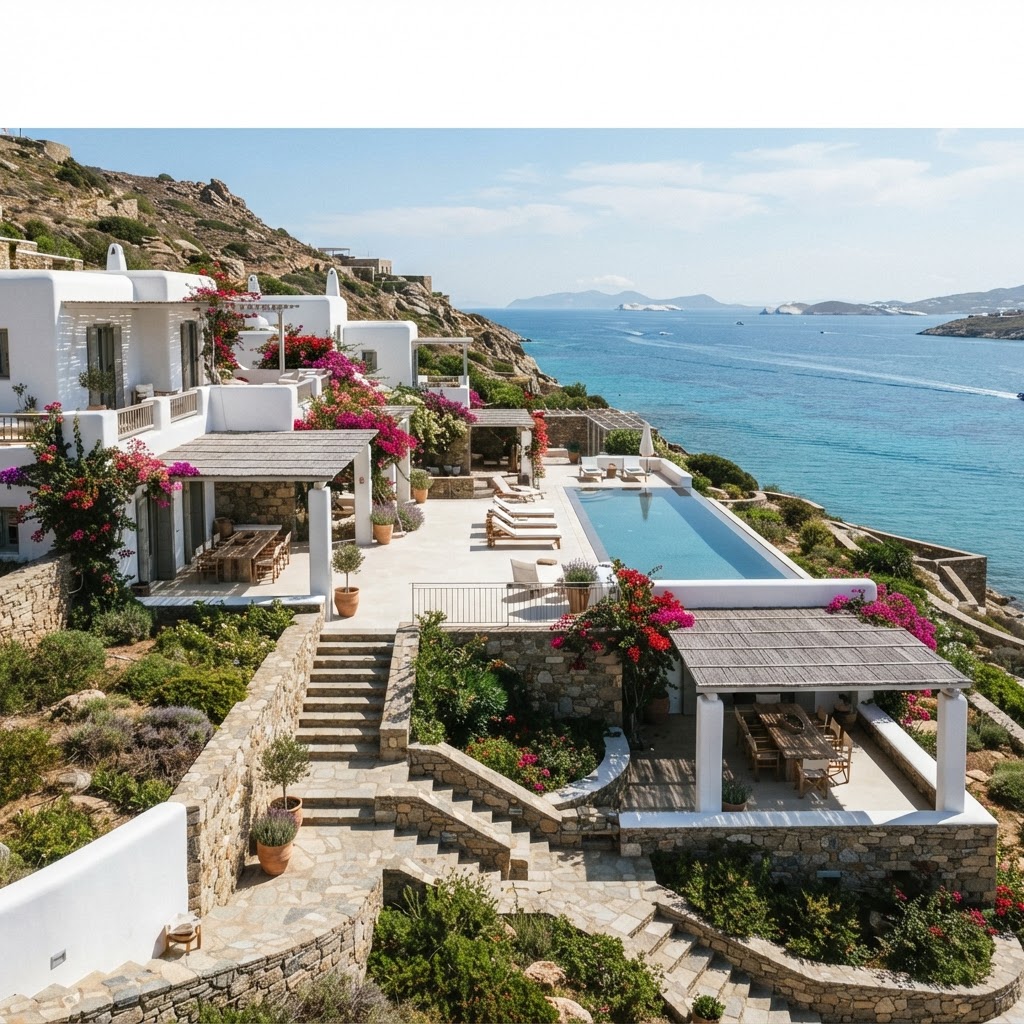
The Italian word for this is la dolce disposizione — the sweet arrangement — and it is why a mediocre Mediterranean villa can feel more hospitable than a meticulously detailed northern one. The southern tradition has spent two thousand years perfecting the art of arranging shade, water, stone and view so that the house extends outwards into the landscape rather than sealing itself against it.
What the Sea Teaches
There is a reason that yacht designers and coastal architects speak the same language. Both must solve the same fundamental problem: how to make a small, self-contained space feel generous, and how to relate every surface to the horizon. A well-designed yacht saloon, like a well-designed coastal living room, is not a room in the ordinary sense; it is a frame around a view, and every decision — the height of the sill, the orientation of the seating, the colour of the surfaces — is subservient to that frame.
The discipline of designing at sea, where space is precious and the environment is hostile, has always informed the discipline of designing at the water's edge on land. The most admired coastal houses share with superyachts a certain restraint: a refusal to fill every corner, an obsession with the quality of light, an understanding that the best material is the one that will weather handsomely, and a conviction that the architecture's first duty is to disappear.
The Edge as a State of Mind
To live well at the water's edge is to accept a particular bargain. The sea will not be tamed; it will only be accommodated. The house that tries to stand against it will, sooner or later, lose. The house that is designed to breathe with it — to open when the weather is kind and close when it is not, to silver and weather, to settle into its rock rather than perch upon it — will endure, and in enduring will become something more than a building. It will become part of the coast.
The houses we remember, from the weathered cabins of the Lofoten to the pale terraces of Naxos, are the ones that were never really finished. They are still being shaped by the wind, the salt and the slow turning of the seasons. That, perhaps, is the truest lesson of architecture at the edge: the best buildings are the ones that allow the environment to keep working on them, so that they belong to the sea rather than merely standing beside it.