When owners weigh up a major refit against replacing a yacht, the real question is rarely just, “Which option costs less today?” The sharper question is which choice protects capital, limits downtime and delivers the best ownership experience over the next five to ten years.
That is why the answer can shift from one programme to another. A well-built yacht with strong bones and the right proportions may justify a serious refit. A platform that no longer fits the owner’s plans, or is nearing heavy technical spend in several areas at once, may point towards replacement instead.
Recent market data makes the decision even more interesting. As of early August 2025, the global fleet of superyachts over 30 metres stood at 6,174 vessels, while close to 2,200 refit yard visits were recorded during 2024. That tells us something simple and useful: refit is not a niche choice. It is a central part of yacht ownership.
When people talk about “saving more”, they are usually thinking about a mix of factors:
- Purchase or project budget
- Time before the yacht is usable again
- Operating costs over several seasons
- Resale strength
- Charter readiness
Yacht refit savings: where existing platforms create value
A refit often saves money because the most expensive parts of the yacht already exist. The hull, superstructure, core engineering architecture and class framework are in place. If those foundations remain sound, the owner can direct spending towards the areas that change day-to-day enjoyment most: interiors, guest amenities, deck arrangements, AV/IT systems, galley upgrades and technical renewals.
That can be a very efficient use of capital. Instead of funding every stage of design, engineering and construction from zero, the owner is improving a proven asset. In many cases, this means the budget goes further in visible, valuable ways.
Timing is another powerful advantage. Industry reporting continues to show that refit activity is strong, and that custom-built yacht lead times can stretch beyond four years. A refit can often return a yacht to service far faster than a replacement new build, especially if the scope is well defined and the yard slot is secured early.
There is also a market infrastructure built around this path. The United States accounted for 21% of recorded refit destinations in 2024, and Italy had 40 active refit facilities, the largest network globally. That depth of yard access helps owners find the right technical fit, whether the project is cosmetic, mechanical or highly complex.
A refit tends to work best when the yacht already has the right core ingredients.
- Best fit: a sound platform with appealing pedigree and proportions
- Main savings: lower capital outlay than a replacement build
- Fastest wins: guest areas, technical refreshes, compliance updates
- Main risk: hidden scope behind linings, machinery spaces or ageing systems
Yacht refit cost risks can appear late
Refit budgets are rarely threatened by the parts everyone can see. They are threatened by the work uncovered once the yacht is opened up.
Corrosion, fatigued pipework, obsolete electrical systems, insulation issues, tank repairs and class-driven upgrades can all shift the budget quickly. That does not mean refit is poor value. It means good value depends on disciplined surveys, realistic contingencies and sharp scope control. The owners who save well through refit usually make their decisions with clear technical reporting, not optimism alone.
Yacht replacement costs: when a new yacht can save money later
Replacing a yacht, whether through a new build, a semi-custom yacht or an in-build resale opportunity, is the higher-spend route at the start. Yet it can still save money over the longer term in the right case.
A new yacht can reduce maintenance exposure in the first years of ownership. Systems are current, warranties are active, layouts are tailored to modern use, and efficiency can improve through better naval architecture, cleaner engine packages and smarter hotel loads. Crew flow, storage, beach club design and owner privacy can also be planned properly from day one, rather than adjusted around legacy constraints.
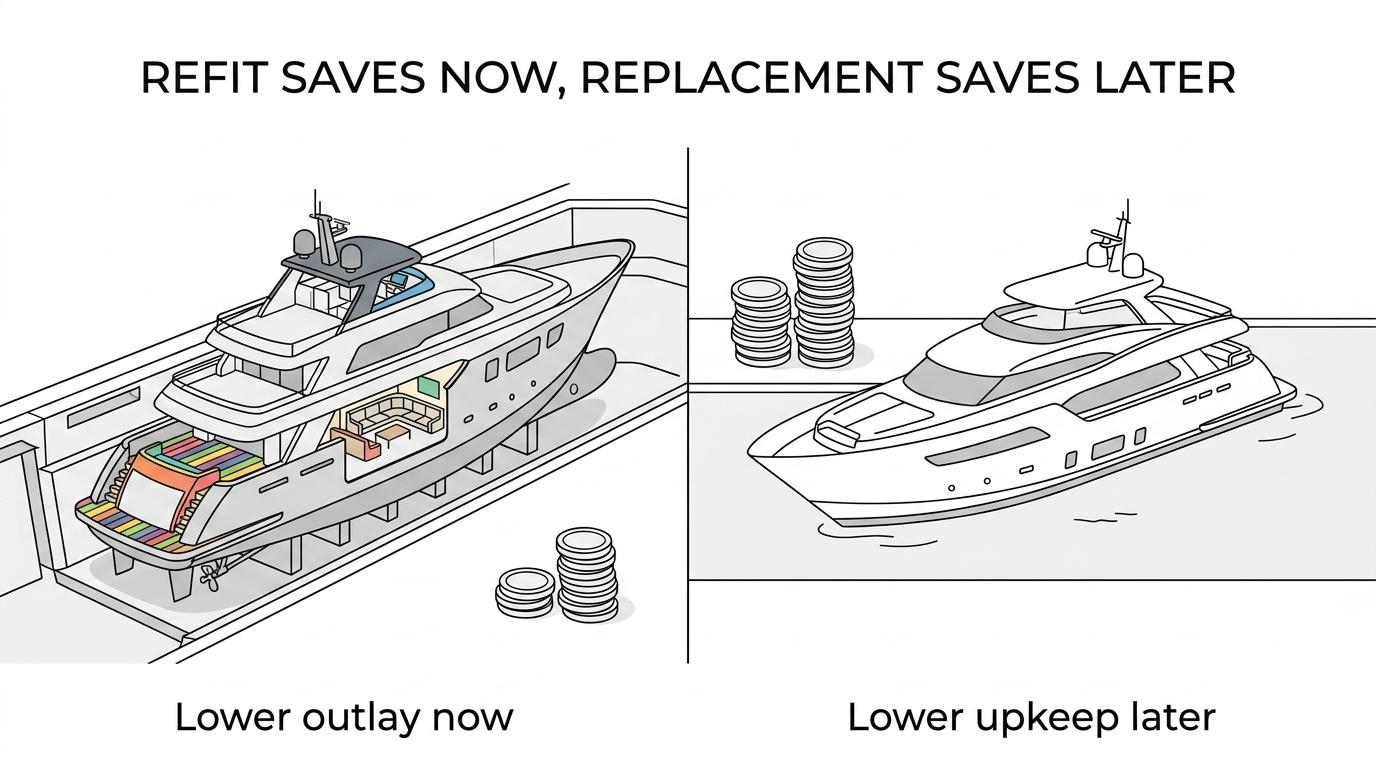
That matters because older yachts can become expensive in a fragmented way. A bit of machinery work here, interior correction there, then class items, then paint, then stabilisers, then HVAC. The owner may never face one giant bill, but a run of medium-sized bills can become more expensive than expected, especially when the yacht still falls short of the desired brief after the spend.
Timing, though, is the major trade-off. Industry sources indicate that production, specification or conversion projects can take less than two years, while a fully custom-built yacht may take more than four years. For owners who want a clean-sheet result, patience is part of the price.
There is one useful middle ground. As of early 2025, the Construction Book for yachts over 30 metres stood at 692 yachts in build, with 219 in-build yachts for sale, around 32% of the total. That creates an important replacement channel. Buying into a yacht already under construction can cut lead time, lower uncertainty and still leave room for personalisation.
Yacht refit vs replacement timing and liquidity in 2025
Cost alone does not settle this decision. Time and liquidity matter just as much. A yacht returning to service next season may produce more real value than a theoretically better platform arriving years later.
The table below sets out the typical trade-offs.
| Factor | Refit existing yacht | Replace with new build or in-build yacht | |---|---|---| | Upfront capital | Usually lower | Usually far higher | | Lead time | Often months, depending on scope | Two years or more, often longer for custom | | Design freedom | Limited by existing platform | High, especially on custom projects | | Technical certainty | Can change after opening up the yacht | Greater predictability during build | | Liquidity profile | Keeps an existing asset in use | Ties capital into a longer pipeline | | Entry into charter or private use | Usually faster | Often delayed by build schedule | | Early operating costs | May stay higher on older platforms | Often lower in the first years | | Resale story | Strong if refit is well judged | Strong if build spec matches market demand |
Liquidity is often overlooked. A refit usually lets the owner keep using an existing yacht while improving value in stages. A replacement programme places more capital into a pipeline that may not produce enjoyment, charter revenue or visible progress for some time. That is not a reason to avoid replacement. It is a reason to price the waiting period properly.
How to measure yacht savings beyond the headline budget
The best decisions are usually made with a five-year view, not a launch-day view. A cheaper project can become expensive if it causes repeated downtime. A larger initial outlay can look sensible if it cuts technical spend, attracts stronger charter interest or improves resale confidence.
A useful evaluation model should include at least these four measures:
- Capital deployed: acquisition cost, refit budget, financing cost and contingency.
- Time out of service: missed owner use, missed charter income and scheduling risk.
- Five-year operating spend: maintenance, fuel, crew efficiency, class items and insurance impact.
- Exit value: resale appeal after the work is complete, or after several years of ownership.
This approach changes the conversation. A refit is not “cheap” if it leaves the yacht due for another major technical period in two seasons. A replacement is not “too expensive” if it resets maintenance exposure and provides exactly the platform the owner wanted all along.
One sentence can save a lot of money here: compare scenarios, not just invoices.
When a yacht refit usually makes more financial sense
Refit often comes out ahead when the yacht has good pedigree, attractive lines, a solid hull and a layout that still works for modern living. If the owner likes the size, range and basic arrangement, a targeted refit can produce a remarkably strong result without the time and capital required for replacement.
This is especially true when the work is focused. Interior redesign, exterior furniture upgrades, bridge technology, connectivity, lighting, spa additions, galley improvement and selective machinery renewal can transform the onboard experience. The owner gets a yacht that feels current, while avoiding the cost of building every tonne from the keel up.
Refit also makes sense when timing matters more than total freedom. An owner planning immediate Mediterranean or Caribbean use, or seeking faster charter readiness, may value quick re-entry into service more than the ability to specify every detail of a future build.
In many cases, the smartest refit is not the biggest one. It is the one with the clearest commercial logic.
When replacing the yacht often delivers better value
Replacement tends to win when the yacht no longer suits the brief at a fundamental level. That may mean the wrong volume, poor crew circulation, dated technical architecture, excessive fuel burn, recurring machinery failures or a compliance path that keeps getting more expensive.
A yacht can reach the point where each new round of work improves only part of the problem. The owner spends heavily, yet the platform still remains old in all the ways that matter most. At that stage, replacement becomes less a luxury choice and more a disciplined capital decision.
There are several common triggers:
- Platform mismatch: the yacht is too small, too old in concept or inefficient in layout
- Technical stacking: multiple large machinery, class and hotel-system costs are approaching together
- Usage shift: the owner now wants longer range, newer wellness spaces, hybrid thinking or stronger charter appeal
- Market opportunity: an attractive in-build yacht for sale shortens the wait and reduces uncertainty
A semi-custom yacht or in-build resale can be the sweet spot here. It offers a fresher platform and shorter lead time than a fully custom programme, while still giving the owner room to shape the finish and specification.
Using technical due diligence to choose refit or replace
The strongest decisions are usually made before any contract is signed. That means pairing a detailed technical inspection with a commercial review of current market options, yard capacity and likely ownership plans.
For owners working with Nicholson, that process often begins with a simple question set. How long is the yacht expected to remain in the fleet? How much downtime is acceptable? Which upgrades are essential, and which are merely attractive? Is the market currently offering in-build yachts for sale that solve the brief faster than a full build? With 692 yachts in the Construction Book in early 2025, and a sizeable in-build resale segment, those alternatives deserve close attention.
A refit can be the smarter saving when it protects a good asset and returns it to service quickly. A replacement can be the smarter saving when it stops a cycle of rising spend on a platform that no longer delivers. The winning choice is rarely the one with the smallest initial number. It is the one that gives the owner the right yacht, at the right time, with the clearest financial logic.