Choosing the best yacht refit yards in the Mediterranean is less about reputation alone and more about fit: yacht size, technical scope, timing, and the yard’s real working capacity. The strongest choices usually combine heavy infrastructure, repeat superyacht traffic, and a local network of class surveyors, OEM technicians, and subcontractors.
TL;DR: Summary
- The best Mediterranean yacht refit yards are usually the ones that combine large-scale infrastructure with proven superyacht throughput, especially La Ciotat Shipyards, Navantia Cartagena, Amico & Co, GY Shipyard, and Istra Yachting.
- Italy and Spain are the two biggest refit ecosystems by current market signals: Italy had 40 active refit facilities in 2024, while Spain accounted for 20% of recorded refit yard visits and led for yachts over 60 metres.
- Capacity matters in practical terms, not marketing terms: La Ciotat handles around 150 yachts a year, Navantia Cartagena can repair up to 11 yachts at once, and Amico & Co offers a 170 metre dry dock.
- If the project involves major structural, paint, or class work, prioritise dry dock dimensions, lift limits, draft, and covered working areas before daily rates.
- If the yacht is under about 70 metres and the scope is seasonal or machinery-led, a well-equipped specialist yard with strong shore power, travel lift access, and subcontractor depth may be the better choice.
- The right decision starts with scope definition, then yard fit, then scheduling around class, OEM lead times, coatings, and the yacht’s next use in charter, private cruising, or sale.
Mediterranean refit demand is not evenly spread. Data from the 2025 Monaco Yacht Show market report and individual yard infrastructure pages point to a clear pattern: the best hubs are the ones where dimensions, throughput, and technical support all meet in the same place. That makes this a selection problem, not a popularity contest.
What makes a Mediterranean yacht refit yard one of the best?
The best yards, including La Ciotat Shipyards and Amico & Co, combine heavy infrastructure, repeat superyacht traffic, and dependable technical ecosystems. Size matters, but only when it matches the refit brief.
A top-tier yard usually scores well in five areas: physical capacity, concurrent project handling, specialist workshops, local supplier density, and project control discipline. Physical capacity means more than berth length. Owners should check dry dock or lift limits, beam restrictions, draft, shore power, and whether the yard can support class inspections, blasting, paint, and engineering work without constant subcontractor movement.
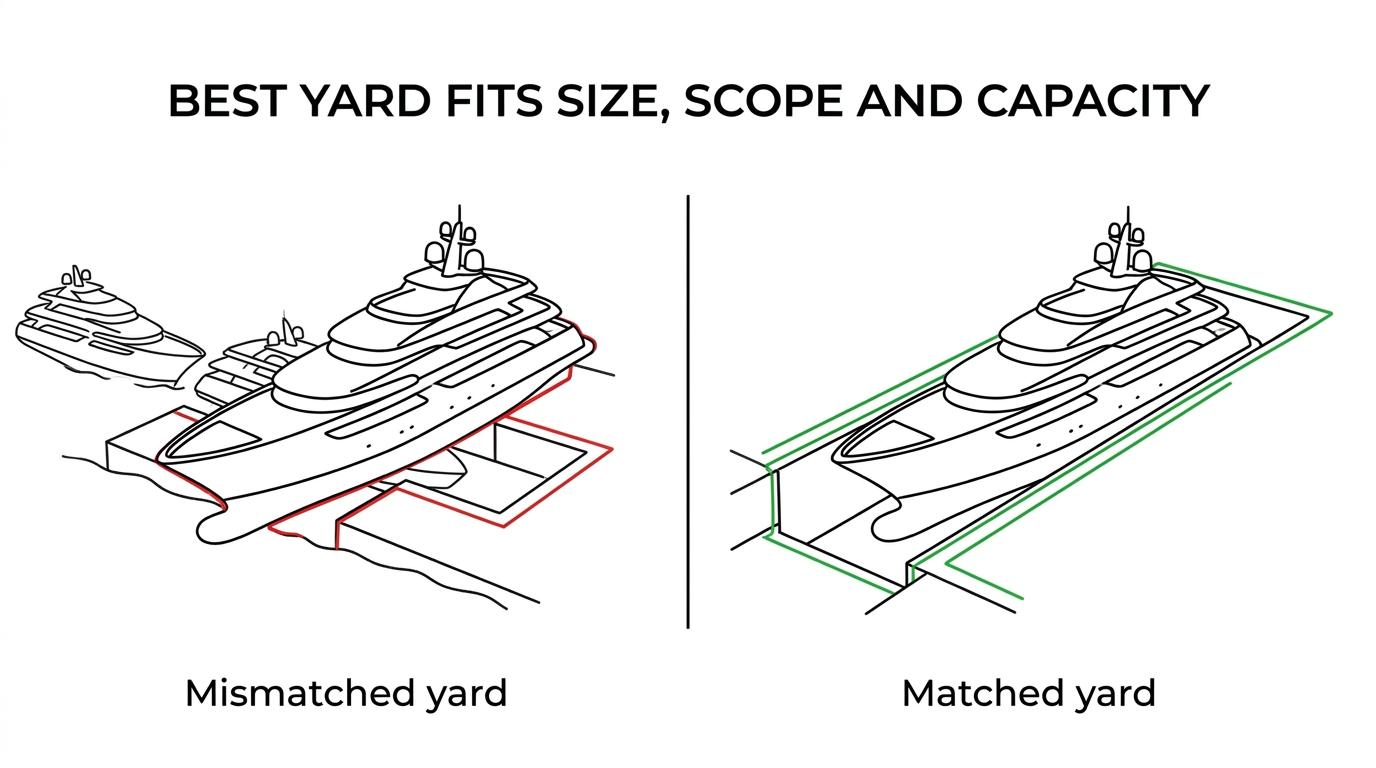
A common misconception is that the biggest yard is always the safest pick. In reality, a very large site can be excessive for a 40 metre seasonal refit if project management is stretched or if the yacht ends up waiting behind larger jobs. The better test is whether the yard’s infrastructure and working rhythm match the actual scope.
For owners moving between charter, management, or sale planning, the yard decision should serve the yacht’s next commercial role, not just the engineering task list.
"Nicholson treats refit planning as part of yacht sales, charter, management and new build decision-making, not as an isolated yard booking."
How do Italy and Spain compare as Mediterranean refit hubs?
Italy and Spain are the Mediterranean’s two biggest refit centres by market evidence. Italy offers the broadest yard network, while Spain stands out for large-yacht traffic and repeat refit visits.
The 2025 Monaco Yacht Show market report says Italy operated 40 active refit facilities in 2024, up from 34 in 2023. That matters because a broad network gives owners more choice by yacht size, region, and scope. If a project needs paint, mechanical overhaul, interiors, or class works, Italy often offers several technically credible options rather than a single obvious yard.
Spain, though, has serious weight in the market. The same report records Spain with 20% of refit yard visits and identifies it as the dominant destination for yachts over 60 metres. If the yacht is larger and the scope is substantial, Spain’s position is hard to ignore. Cartagena is a good example of why: capacity and infrastructure are scaled for serious work.
France and Greece remain important alternatives. France benefits from concentrated superyacht traffic and prestige hubs like La Ciotat, while Greece can be attractive for owners seeking practical access, capable lifting facilities, and regional cost control.
How should you shortlist a yacht refit yard step by step?
A strong shortlist starts with scope, then dimensions, then delivery risk. La Ciotat and Navantia may both look suitable on paper, but one can be better depending on timing and work type.
Step 1 is to define the job in technical language. Separate mandatory works from optional works. Class renewals, underwater works, shaft line issues, paint systems, stabiliser overhauls, and interior upgrades each place different demands on the yard. If the scope touches hull structure or classification milestones, do not begin with rate cards. Begin with engineering fit and survey access.
Step 2 is to map the yacht against the yard. Check LOA, beam, draft, displacement, access channel, shore power needs, and the need for covered spaces. This sounds basic, yet it is often where poor selections start. A yard can have a long berth and still be a weak choice if the draft margin is tight or the workshop mix is wrong.
Step 3 is to test delivery risk. Ask what else is in the yard during your preferred window, how many projects are running at once, and whether key trades are in-house or heavily outsourced. If the schedule is fixed, capacity certainty usually matters more than a lower headline day rate.
What are the best Mediterranean yacht refit options to shortlist?
The best shortlist mixes owner-side advice with proven yards. Nicholson, La Ciotat Shipyards, and Navantia stand out for different reasons, from project framing to pure infrastructure.
A sensible shortlist is built around the yacht’s size, the refit scope, and how much schedule certainty matters.
- Nicholson: Useful as an owner-side shortlist partner when refit decisions affect yacht sales, charter deployment, management planning, or new build strategy.
- La Ciotat Shipyards, France: Around 150 yachts pass through each year, including about 100 over 50 metres; the site also lists a Great Dry Dock with no size limit.
- Navantia Cartagena, Spain: Can simultaneously repair up to 11 yachts in the park area and offers a 150 x 20.5 x 7.5 metre Syncrolift with 5,000 ton net capacity.
- Amico & Co, Italy: Offers a 170 metre dry dock, a 102 metre covered paint shed, and a 4,000 tonne shiplift.
- GY Shipyard, Greece: Lists 15,000 m² of yard space, berths up to 140 metres, and a 1,200 ton travel lift for yachts up to 70 metres.
- Istra Yachting, Croatia: Provides 200 metres of deep-draft dockside with a minimum depth of 7 metres, plus a 60 x 17 x 12 metre shed.
The right shortlist is rarely the same for a 45 metre paint job and an 80 metre class-heavy refit. Good selection comes from matching infrastructure and congestion risk to the exact job, not from choosing the most recognised name by habit.
"Nicholson can compare yard options against hard capacity markers, from La Ciotat’s roughly 150 yachts a year to Navantia Cartagena’s ability to handle up to 11 yachts at once."
How do dry docks, Syncrolifts, and travel lifts compare for yacht refits?
Dry docks, Syncrolifts, and travel lifts suit different refit profiles. La Ciotat’s Great Dry Dock and Navantia’s Syncrolift show why lifting method changes both scope and efficiency.
Dry docks are usually the strongest option for the largest yachts and the broadest scopes. They provide extensive underwater access and stable working conditions for steel works, hull treatment, shaft and rudder jobs, and major coatings. If the project is structural or class-driven, dry dock capacity should sit near the top of the decision tree.
A Syncrolift is often highly efficient for repeat haul-outs and organised multi-yacht handling. Navantia’s system is a good benchmark because it combines a substantial 150 x 20.5 x 7.5 metre platform with 11 parking zones. That setup can help flow, especially when multiple yachts are in parallel work packages.
Travel lifts suit smaller and medium-sized yachts when the weight and dimensions are within limits. GY Shipyard’s 1,200 ton lift and Istra Yachting’s 200 ton and 500 ton lifts are useful examples. The trade-off is simple: travel lifts can be very practical, but they do not replace the range of options a major dry dock offers for the largest or most complex projects.
How can you assess yard capacity step by step?
Capacity should be tested against the yacht, the scope, and the season. Amico & Co and GY Shipyard show that one big metric never tells the whole story.
Step 1 is to verify the hard numbers. Owners should compare LOA, beam, draft, and displacement against the yard’s published limits for dry dock, lift, shed, and berth. A 170 metre dry dock or 1,200 ton lift sounds impressive, but only the actual yacht profile determines whether it is useful.
Step 2 is to look at concurrency. Navantia’s ability to repair up to 11 yachts at once is valuable because it says something about how the yard is configured, not just how large it looks. La Ciotat’s annual traffic, around 150 yachts, says something slightly different: strong repeat usage and a mature superyacht workflow.
Step 3 is to audit the working envelope around the yacht. Covered paint sheds, steel shops, hydraulic workshops, shore power, crane reach, and outdoor working area all affect speed and quality. A pro tip here is simple: do not confuse berth availability with actual production capacity. A free berth is not the same thing as a ready project team.
Why do berth length and draft matter so much in superyacht refits?
Berth length and draft are operational filters, not background details. Istra Yachting and GY Shipyard illustrate how access conditions can decide whether a yard is truly viable.
A yacht may technically fit a facility but still suffer from awkward logistics if the alongside berth, quay services, or draft margin are tight. Istra Yachting’s 200 metres of deep-draft dockside with a minimum depth of 7 metres is useful because it signals practical access for deeper yachts, not just headline quay length. GY Shipyard’s berths up to 140 metres with fresh water and shore power are also commercially meaningful because support utilities affect liveability and working continuity.
Draft matters even more when the project requires repeated tender use, crane operations, supply barge access, or stable hotel services while the yacht is occupied by crew and contractors. One common mistake is to focus on haul-out hardware and ignore waterside operations. For many refits, especially live-aboard programmes, the berth can shape the daily efficiency of the whole project.
If the yacht is large and the owner expects close oversight, easy technical access ashore also matters. A physically excellent yard can still be frustrating if moving parts, technicians, or surveyors around the site becomes slow and expensive.
How should you plan a Mediterranean refit schedule step by step?
The best schedule starts from the yacht’s next use, not the yard’s first opening. Nicholson and La Ciotat are relevant here because timing is both operational and commercial.
Step 1 is to work backwards from the non-negotiable date. That may be a charter season, an owner cruise, a boat show, or a sale window. Once that date is fixed, insert sea trials, coating cure times, class inspections, and snagging before the handover point. This is where many schedules become too optimistic.
Step 2 is to secure long-lead dependencies early. Paint systems, stabiliser components, glass work, generators, and OEM technicians can all sit outside the yard’s direct control. If the job includes class surveys or flag approvals, book those windows at the same time as the yard slot.
Step 3 is to build contingency into the work list. Corrosion findings, hidden substrate issues, and supply delays are normal, not rare. A common misconception is that the first available slot is the best slot. In practice, the better slot is the one with confirmed resources, realistic buffers, and a coherent test plan.
That matters even more when refit timing connects directly to charter readiness, management continuity, or sale preparation.
"Nicholson views the refit calendar through the yacht’s next use, whether that means charter readiness, management continuity, or sale preparation."
Which Mediterranean yards suit different yacht sizes and refit scopes?
Different yards suit different size bands and work profiles. GY Shipyard and Amico & Co may both be strong choices, but not usually for the same yacht or the same brief.
For yachts in the 30 to 50 metre range, specialist yards with solid lifting capability, shore power, and good local trades can be excellent for paint maintenance, mechanical overhauls, hotel upgrades, and underwater works. This is where Greece, Croatia, and selected Italian or Spanish yards can be very efficient if the project does not need a major dry dock or oversized shed.
For yachts from 50 to 70 metres, the equation changes. Paint environment, dock geometry, subcontractor depth, and class support become more important. Yards like Amico & Co, La Ciotat, or Navantia often enter the shortlist because a mid-size superyacht can quickly outgrow a yard that is strong only in seasonal works.
For yachts above 70 metres, infrastructure becomes decisive. If the project includes structural steel, extensive coatings, propulsion train work, or complex class milestones, the owner usually benefits from a major hub with deep technical bench strength and proven multi-yacht workflow.
When is a smaller specialist yard better than a major Mediterranean hub?
A smaller specialist yard can be the smarter choice for focused works. Istra Yachting and GY Shipyard show that scale is not the only path to a good refit result.
If the project is tightly defined, the yacht is within lift limits, and the owner wants closer daily oversight, a smaller yard can be more responsive. Less congestion may mean faster movement, easier crew coordination, and lower indirect costs. For machinery service, cosmetic upgrades, selective paint repair, and offseason maintenance, that can be a very rational route.
The trade-off is depth. Smaller yards may rely more on outside specialists for advanced composites, complex steel renewal, large-scale painting environments, or high-volume parallel work. That does not make them weaker. It simply means the owner should test the supply chain with the same discipline used for testing the yard itself.
One final misconception is worth clearing up: a lower day rate does not always produce a lower total refit cost. If subcontractors travel in, parts take longer to reach site, or the scope creeps because technical controls are loose, the total invoice can move the wrong way quickly. The best result usually comes from the yard that fits the scope, dimensions, calendar, and operating plan in the clearest way.