Extended cruising rewards a different kind of motor yacht. The strongest candidates are not just stylish or fast, but able to carry fuel, stores, crew support and technical resilience over long distances at sensible cruising speeds.
TL;DR: Summary
- The best motor yachts for extended cruising are usually full-displacement or expedition-style models with 3,000+ nm published range, strong fuel capacity and offshore-minded layouts.
- Published standouts include Benetti Luminosity at 8,000 nm at 11 knots, Benetti B.Yond 57M at 5,000 nm at 10 knots, Benetti Class 44M at 4,100 nm at 11 knots, Lürssen Starfire at 4,000 nm at 12 knots, and Nordhavn long-range models around 3,000 nm or miles depending on the model and source.
- Range figures only mean something when you check speed, displacement, fuel reserve, sea state and whether the brochure uses nautical miles or statute miles.
- For most owners, the right extended-cruising motor yacht balances range, stabilisation, accommodation, certification or offshore capability, and serviceability, not top speed alone.
- If you want fewer fuel stops and more route freedom, look at 5,000+ nm yachts; if you want serious offshore capability in a smaller package, some Category A or expedition-focused models still make strong sense.
That is why the smartest comparisons start with mission profile, not branding. A yacht intended for long Mediterranean seasons, offshore island-hopping or multi-week passages should be judged on hull form, operating envelope and liveaboard practicality before aesthetics.
Why are some motor yachts better for extended cruising?
Extended cruising favours full-displacement or expedition motor yachts. Benetti B.Yond 57M and Nordhavn 51 show why: published long range, offshore capability and practical systems matter more than peak speed.
The core criteria are usually simple. You want a yacht that can cover meaningful mileage without constant refuelling, remain comfortable at sea for days rather than hours, and support life on board with enough storage, crew functionality and machinery access. That is why fuel capacity, cruising speed, stabilisation and hull efficiency tend to matter more than a glamorous brochure speed.
A common mistake is to start with top speed and work backwards. For extended cruising, the better question is this: at 10 to 12 knots, how far can the yacht really go, in what load condition, and with what reserve left?
"Nicholson assesses luxury yacht sales, charter, management and new build construction together, which matters when an extended-cruising brief has to work both offshore and in port."
Published examples support that logic. Benetti specifies the B.Yond 57M at 5,000 nm at 10 knots, while Nordhavn describes the 51 as CE Category A for serious offshore use with a published 3,000-mile range. Those are not weekend-boat numbers. They reflect a design brief centred on sustained passage making.
How do full-displacement and planing motor yachts compare for long-range passages?
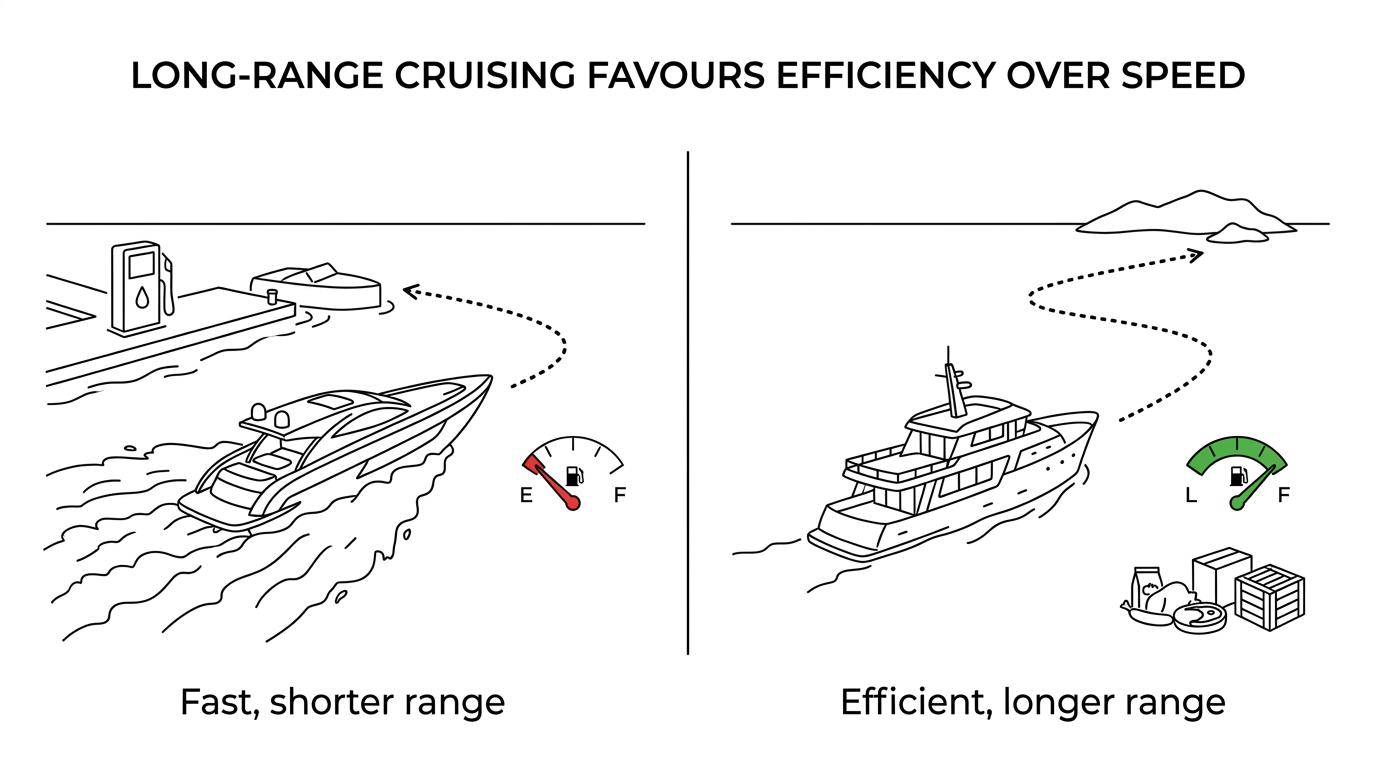
Full-displacement yachts usually win on range, while planing yachts win on speed. Nordhavn 51 and Lürssen Starfire illustrate the trade-off: efficient passage making at 10 to 12 knots versus higher-speed cruising with heavier fuel burn.
A full-displacement hull is designed to move efficiently through the water at moderate speed. That tends to suit long-range cruising because the yacht carries its fuel, provisions and technical systems without fighting its own operating profile. Expedition yachts sit close to this logic, often with robust build philosophy, generous tankage and layouts that remain workable in offshore conditions.
Planing or semi-planing yachts can still cruise extensively, but the economics and rhythm are different. You gain pace, yet usually sacrifice some range and fuel efficiency. If your cruising plan is coastal, marina-rich and weather-selective, that may be fine. If the plan includes long legs, fewer bunkering options or a stronger preference for autonomy, displacement tends to make more sense.
Another misconception is that stabilisation alone turns a fast yacht into a long-range yacht. Stabilisation helps comfort. It does not create fuel endurance, service access or offshore operating margins.
What are the top motor yachts for extended cruising?
Several published motor yachts stand out for extended cruising. Benetti Luminosity, Starfire and Nordhavn N120 each pair serious range with operating profiles aimed at time offshore rather than short coastal hops.
When looking at current published specifications, a few models and named yachts repeatedly surface as strong benchmarks:
- Benetti Luminosity: specified with an 8,000 nm range at 11 knots, which puts it in rare long-range territory among large motor yachts.
- Benetti B.Yond 57M: published at 5,000 nm at 10 knots, with a clear voyager positioning rather than a pure high-speed profile.
- Benetti Class 44M: published at 4,100 nm at 11 knots, with accommodation for 10 guests in 5 cabins and 9 crew in 5 cabins.
- Lürssen Starfire: listed by Boat International with a maximum cruising range of 4,000 nm at 12 knots, plus a 14-knot cruising speed.
- Nordhavn N120: listed with 17,500 gallons of fuel, a 10-knot cruising speed, and an approximate 3,000 nm range at reduced speeds.
- Nordhavn 51: described as CE Category A for serious offshore use, with a published 3,000-mile range.
The comparison needs care, because not every builder uses the same language or units. “Maximum cruising range”, “range at reduced speeds” and “3,000 miles” are not interchangeable phrases. Ask whether the figure is in nautical miles, what speed was used, and what reserve fuel assumption sits behind it.
"Nicholson uses published range, accommodation and offshore-capability data to separate true long-range motor yachts from faster coastal designs."
How should you shortlist an extended-cruising motor yacht step by step?
A strong shortlist starts with mission, not brand. Nicholson and Benetti examples are easiest to compare when you define passage length, guest load and crew model before looking at styling or deck features.
Most poor shortlists fail because the owner mixes incompatible use cases. A yacht built for six guests with light crew support is not the same proposition as a yacht intended for longer offshore runs with full service on board.
- Define the operating pattern first. Decide whether the yacht is for Mediterranean cruising, itinerary planning, or mixed private and charter use.
- Set a minimum range threshold. For extended cruising, 3,000 nm is a useful baseline; 4,000 to 5,000+ nm opens more freedom and reserve planning.
- Match the crew model. If you want a highly serviced liveaboard programme, look for stronger crew accommodation and technical access.
- Rank the non-negotiables. Stabilisation, Category A certification, tender storage, refrigeration, laundry, workshop space and spare-parts capacity often matter more than an extra knot.
If two yachts look similar on paper, compare their intended operating philosophy. One may be a stylish cruising yacht with respectable endurance; the other may be a genuine passage-making platform.
How do published range figures actually work in the real world?
Published range figures are useful, but only with context. Nordhavn 51 and Benetti Class 44M show why speed, load, sea state and reserve fuel can change the real-world outcome.
Range is not a fixed truth. It is an estimate under stated or implied conditions. Builders may quote range at cruising speed, at reduced speed, or as a maximum cruising range. Each phrasing matters. A yacht that can travel 4,000 nm at 12 knots is answering a different question from a yacht that reaches 3,000 nm only at reduced speeds.
Units also matter more than many buyers realise. Nordhavn 51 is published with a 3,000-mile range, while other yachts are commonly quoted in nautical miles. If you do not normalise the units, the comparison is flawed before you start.
"Nicholson's heritage, expertise and industry knowledge are most useful when brochure figures need to be tested against real operating assumptions."
There is also a reserve issue. Good seamanship does not plan a yacht to arrive empty. If weather changes, currents build or diversion is needed, reserve fuel becomes part of the real range calculation. Ask for the speed-to-consumption curve and the load condition behind the brochure number.
How do 3,000 nm and 5,000+ nm motor yachts compare in itinerary freedom?
A 3,000 nm motor yacht and a 5,000 nm motor yacht serve different cruising ambitions. Nordhavn 51 and Benetti B.Yond 57M may both be capable, yet refuelling freedom and reserve planning are not the same.
At roughly 3,000 nm, a yacht can already be a serious offshore platform if the design, certification and systems support the mission. This band often suits owners who want confidence offshore without stepping into a much larger operating footprint.
At 4,000 to 5,000+ nm, the character changes. You gain more flexibility in weather routing, more margin for detours and wider choice in bunkering strategy. That does not mean every owner needs the longest-range yacht available. It means the operational stress can be lower when the yacht carries deeper endurance.
If your cruising plan includes remote areas or long periods away from major marinas, extra range is not just convenience. It becomes a planning asset. That kind of autonomy is not only about fuel, and WaterNordic’s look at 12V osmoseanlæg til båd og autocamper makes the broader point that onboard water-making capacity can materially reduce dependence on port calls during longer cruising windows.
How can you verify brochure claims before you buy or charter?
Brochure claims should be checked against operating data. Starfire and Nordhavn N120 are better judged through speed-range curves, load assumptions and fuel-consumption records than headline figures alone.
This is where due diligence becomes practical rather than theoretical. Many attractive yachts remain strong candidates after scrutiny, but the scrutiny has to happen.
- Request the speed-range curve: ask for fuel burn at several speeds, not one headline figure.
- Check the load condition: confirm whether tanks, water, tenders, toys and stores were included.
- Clarify the unit: make sure “miles” means nautical miles if that is how you are comparing the fleet.
- Ask for operating evidence: sea-trial data, captain’s logs and owner records are more useful than brochure language.
- Review machinery access: a long-range yacht should be maintainable underway, not only in port.
One practical tip is to ask how the yacht behaves at the speed you will actually use most often. If you expect to cruise at 11 knots but the best efficiency sits well below that, the headline range may not reflect your real routine.
How should accommodation, crew and storage be matched to liveaboard use?
Accommodation planning decides whether a yacht feels workable after week two. Benetti Class 44M and Nordhavn 51 highlight the difference between guest capacity, crew support and owner-operator practicality.
Extended cruising exposes layout flaws quickly. A yacht can look excellent for day use and still feel constrained once weeks of clothing, spares, food, laundry cycles and watchkeeping start to shape daily life.
- Start with guest pattern. Count the number of people who will actually stay aboard for long legs, not peak event capacity.
- Map crew support to service expectations. A yacht with 10 guests in 5 cabins, like the Benetti Class 44M, also carries 9 crew in 5 cabins for a reason.
- Audit storage honestly. Dry stores, freezer space, luggage, technical spares and tender gear all compete for volume.
- Separate private and working zones. Long stays are easier when crew movement, galley work and machinery access do not interfere with guest space.
A common error is assuming that berth count equals cruising comfort. It does not. The right measure is whether the yacht can sustain the people aboard without constant compromise.
Which features matter most for offshore comfort and risk reduction?
Offshore comfort comes from systems, not décor. Nordhavn 51 and Luminosity point to the key items: certification, stabilisation, sound control, redundancy and layouts that stay usable at sea.
Start with the hull and operating category. CE Category A is a serious marker for offshore intent in the smaller-yacht market. Add stabilisation, then look deeper at noise, vibration, tank placement, handholds, watchkeeping visibility and machinery redundancy. Benetti describes Luminosity’s navigation experience as stable, vibration-free and soundless, which highlights how comfort at sea is partly an engineering question.
Another useful check is whether the yacht remains liveable while moving. Can meals be served safely? Can crew reach systems quickly? Can guests use key spaces without feeling every motion? If the answer is no, the yacht may be beautiful but less suited to extended passages.
When is a larger expedition yacht better than a smaller offshore motor yacht?
Bigger is not always better for extended cruising. A Benetti B.Yond 57M and a Nordhavn 51 solve different problems, and the right answer depends on route, crew budget and how independently you want to cruise.
A larger expedition yacht is often the better answer when you want long range plus high guest comfort, meaningful crew infrastructure and the ability to carry tenders, toys and stores without squeezing the living programme. The trade-off is cost, complexity and port selection.
A smaller offshore-capable motor yacht can be the better answer if autonomy, simpler logistics and a tighter operational footprint matter more than maximum volume. If your plan is owner-led cruising with disciplined systems management, smaller can be efficient and satisfying. If your plan includes long seasons with multiple guests and high service standards, larger usually becomes easier to live with.
The right question is not “Which yacht is best?” It is “Which operating model do I want to live with for the next 30 days at sea?”