Buying a yacht is not the moment for guesswork. A sea trial is where the brochure, the specification sheet, and the seller’s description meet real water, real load, and real operating conditions. It is the closest thing to a practical exam a yacht will sit before a buyer commits.
A good yacht sea trial checklist does more than confirm that the boat moves and turns. It helps a buyer test propulsion, steering, navigation, safety gear, onboard systems, ride quality, and comfort while the yacht is doing the work it was built to do. Just as importantly, it helps keep emotions in check. Even a beautifully presented yacht needs to prove itself underway.
Why a yacht sea trial checklist matters for buyers
A sea trial is often described as the marine equivalent of a test drive, but that comparison is a little too simple. Cars operate on predictable roads. Yachts operate in changing wind, current, traffic, and sea state. That means the trial should be structured, documented, and linked to the wider survey process.
Many buyers are surprised to learn that the sea trial is rarely a standalone event. In practice, it often sits alongside an in-water inspection, a haul-out, and a fuller pre-purchase survey. Surveyors commonly look at how the yacht behaves underway and connect those observations to findings on structure, running gear, and onboard systems. A vibration underway, for example, may point back to a propeller issue or shaft alignment concern found elsewhere in the inspection.
This matters because a yacht can look excellent at the dock and still reveal weaknesses once it is loaded, accelerated, turned hard, or asked to run at cruising speed for a sustained period.
How the yacht sea trial fits into the survey process
The strongest buying process treats the trial as one part of a wider technical review. Accredited marine surveyors bring value here because they are trained to assess condition, construction, damage, and fair market context, not just obvious cosmetic issues. Where engines are sophisticated or high-value, an engine surveyor or factory-trained technician may also be involved to run diagnostics, review maintenance data, and carry out performance checks.
That combination matters. The general surveyor may focus on hull condition, systems, safety, and operation, while the engine specialist can examine digital readouts, compression, oil analysis, service history, and performance against manufacturer expectations. Together, those findings give the buyer a far clearer picture than a casual sea outing ever could.
In many cases, the seller, captain, owner’s representative, or broker will operate the yacht during the trial. That is normal. The buyer’s role is to observe closely, ask precise questions, and make sure every agreed test is actually completed.
After the offer is accepted, the purchase terms should usually remain dependent on a satisfactory survey and sea trial result.
Pre-trial preparation for a yacht sea trial
Preparation affects the quality of the trial more than many first-time buyers expect. If the yacht is not fully operational on the day, the results can be incomplete or misleading. A sea trial should not be used to confirm that basic repairs are still needed before proper testing can begin.
Before stepping aboard, it helps to agree the route, the test sequence, and who will be present. It also helps to decide what “satisfactory” means for this yacht. A fast planing motor yacht, a long-range displacement yacht, and a sailing yacht will each have different priorities.
A practical pre-trial setup usually includes:
- service and maintenance records
- surveyor attendance
- engine specialist attendance where needed
- fuel and water levels noted
- safety gear ready for inspection
- route planned for open water and close-quarters manoeuvres
Clarity at this stage keeps the trial efficient and reduces the risk of vague answers later.
What to check before leaving the dock
A strong checklist starts while the yacht is still secured. Much can be learned before the lines are cast off. Cold-start behaviour is one of the first signs buyers should watch. Were the engines already warmed up before arrival? Do they start cleanly? Is there unusual smoke, noise, hesitation, or alarm activity?
This is also the right time to test helm visibility, instrumentation, communications equipment, thrusters, windlass controls, and basic ergonomics. A yacht may perform well in open water but still feel awkward or compromised at the helm. Sightlines matter, particularly from the main steering position during docking and low-speed manoeuvres.
At the dock, buyers and surveyors often focus on these points:
- Engine start-up: cold-start response, smoke, noise, alarms
- Helm station: visibility, screen readability, switch layout
- Safety equipment: lifejackets, extinguishers, EPIRB, flares, bilge alarms
- Electrical systems: batteries, generators, shore power transfer
- Deck operation: windlass, cleats, passerelle, thrusters, controls
The goal is simple: no surprises once the yacht is in open water.
Underway yacht sea trial checklist for performance and handling
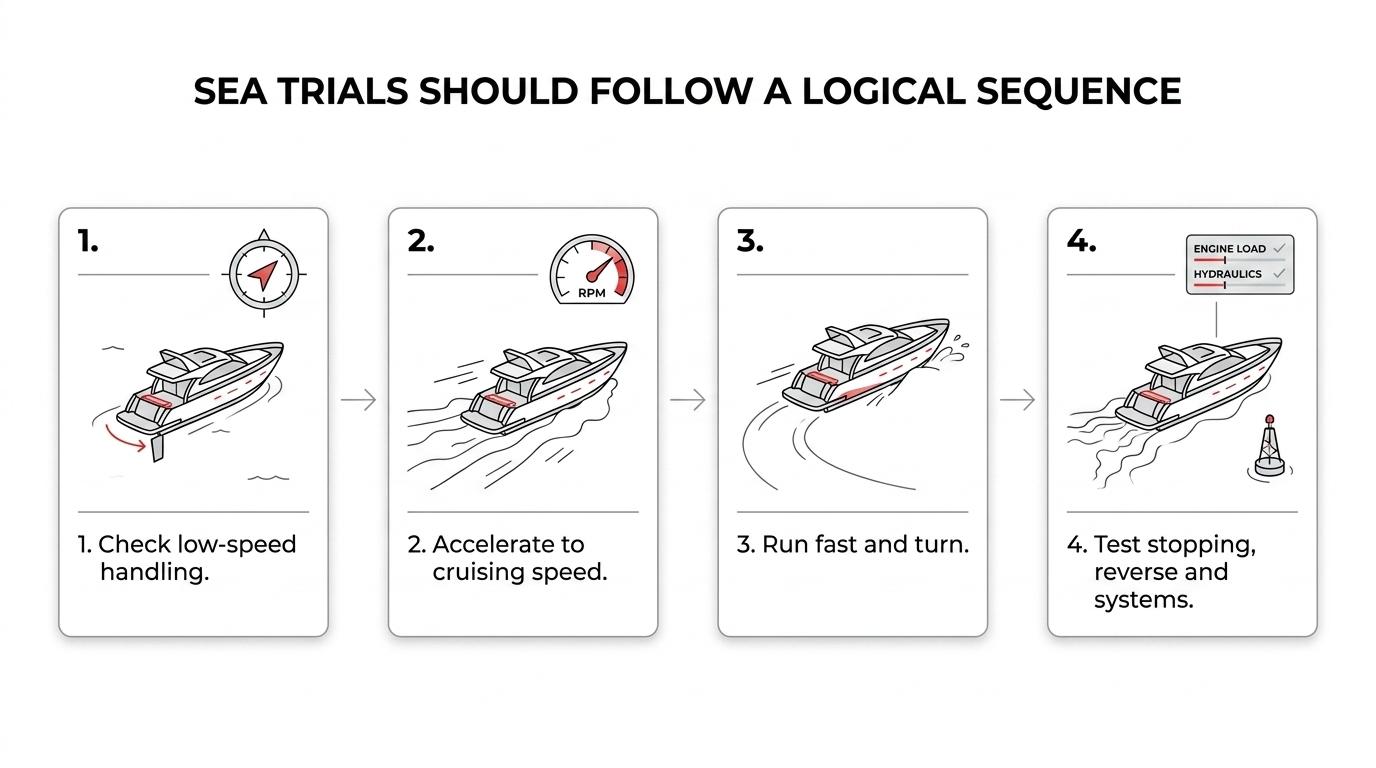
Once underway, the sea trial should move through a logical sequence. Low-speed handling comes first, then acceleration, cruising performance, higher-speed runs where appropriate, turns, stopping, reverse operation, and steady-state checks. The yacht should not merely be driven in a straight line for twenty minutes and then brought back to the berth.
Handling is one of the most revealing parts of the day. Does the yacht track straight? Does she respond predictably to helm input? Is there excessive bow rise, spray, vibration, cavitation, pounding, or rattling? Does the steering feel precise or vague? These details affect confidence just as much as headline speed.
Comfort matters too. Buyers should pay attention to noise levels, sightlines from the saloon and bridge, motion at different points onboard, and how easy it is to move safely while the yacht is running. A yacht intended for family cruising or charter use must feel secure, not just impressive.
Here is a simple working table for the main checks underway:
| Trial stage | What to assess | Warning signs | |---|---|---| | Idle and no-wake speed | Steering response, engine smoothness, thruster operation | Hunting revs, poor steerage, harsh vibration | | Acceleration | Time to plane if applicable, turbo response, visibility | Excess smoke, sluggish pickup, alarms | | Cruising speed | Engine load, temperatures, trim, noise, fuel burn data if available | Overheating, unstable trim, unusual resonance | | Maximum rated rpm | Ability to reach expected rpm and performance range | Under-revving, overheating, excessive smoke | | Hard turns and manoeuvres | Grip, roll behaviour, steering feel, cavitation | Prop ventilation, heavy lean, delayed response | | Reverse and stopping | Gear engagement, control precision, stopping confidence | Clunking, delayed engagement, poor control | | Systems under load | Generator, stabilisers, air conditioning, navigation electronics | Dropouts, faults, electrical instability |
A well-run trial will also test autopilot, radar, chartplotter, VHF, horn, trim tabs, stabilisation systems where fitted, and any monitoring software tied to the engines or ship’s systems.
Yacht systems to test during the sea trial
A buyer should think beyond engines. The yacht is an ecosystem of connected systems, and problems often show up only when several functions are running at once. Air conditioning can behave differently under generator load. Electronics may glitch once the yacht is pounding lightly in a chop. Bilge pumps, alarms, and monitoring systems need to be seen in operation, not simply ticked off a spec sheet.
Where possible, the surveyor should test onboard systems while underway. That is often when weaknesses become visible. Pumps cycle differently, voltage patterns change, and loose fittings or worn mounts reveal themselves through sound and movement.
Systems worth testing include:
- navigation electronics
- communications equipment
- generator performance
- stabilisers
- trim tabs
- bilge and alarm systems
- domestic water and heads
- galley equipment under power
- air conditioning and ventilation
For larger yachts, management systems and digital control interfaces deserve close attention. One intermittent electronic fault can become a recurring operational issue later.
Sea trial questions for the surveyor and engine specialist
The best buyers do not try to perform the survey themselves. They use the sea trial to ask sharper questions and record clearer answers. That keeps the decision grounded in evidence.
A few well-aimed questions can quickly separate routine wear from a more serious issue. If the yacht is not hitting target rpm, ask whether the likely cause is load, fouling, propeller condition, engine health, or instrumentation. If vibration appears at a certain speed, ask whether it points to running gear, mounts, shaft alignment, or hull impact.
Useful questions include:
- What findings are cosmetic, and what findings affect safety or value?
- Are engine readings in line with manufacturer expectations?
- Do any vibrations or noises suggest running gear problems?
- Which systems need immediate attention, and which can wait?
- Are there signs of deferred maintenance rather than normal wear?
- Should any issue be reviewed again during haul-out or by a specialist?
These questions also help during price negotiations because they connect defects to likely remedial work rather than vague concern.
Safety checks that should never be skipped during a yacht sea trial
Safety gear should not be treated as a box-ticking exercise. Buyers should confirm both presence and serviceability. Out-of-date flares, expired extinguishers, missing lifejackets, non-functioning bilge alarms, or neglected emergency steering arrangements all tell a wider story about how the yacht has been maintained.
If the yacht is intended for charter, family cruising, or offshore use, safety readiness becomes even more central. Visibility from the helm, secure handholds, deck movement underway, and access to emergency gear all affect how the yacht will function when conditions are less forgiving than on trial day.
Even on a smooth trial, buyers should note:
- Helm visibility: clear forward and lateral sightlines at displacement and planing speeds
- Deck security: handrails, non-slip surfaces, safe movement fore and aft
- Emergency gear access: quick reach to life-saving equipment and shut-offs
- Alarm function: audible and visible warnings that can be recognised immediately
A yacht that feels safe inspires confidence long after the trial is over.
Keeping the purchase contingent on a satisfactory sea trial
One of the most useful disciplines in yacht buying is to keep the process conditional until the technical work is complete. That means the deal should not become emotionally fixed before the trial, survey, and any specialist inspections are reviewed.
A satisfactory result does not mean perfection. Pre-owned yachts nearly always produce a list of findings. The real question is whether the defects are acceptable, repairable within reason, and reflected properly in price and timing. Some issues support a request for remedy before closing. Others justify a price adjustment. A few may be serious enough to walk away.
For buyers working with Nicholson or any experienced brokerage team, the value lies in treating the sea trial as evidence, not theatre. A disciplined checklist, the right surveyor input, and a clear contingency structure create room for a better decision.
What a strong yacht sea trial result looks like
The best sea trial outcome is not simply “everything worked”. It is a result that gives the buyer a dependable picture of how the yacht performs, what needs attention, and what ownership is likely to feel like in practice.
That picture should include verified handling, reliable system operation, credible engine data, confirmed safety readiness, and a surveyor’s view that connects the yacht’s behaviour underway to her broader condition. When those pieces line up, a buyer can move forward with far more certainty, and with the confidence that the yacht has proved herself where it counts most: at sea.