The MYBA charter agreement is often described as a standard form contract. That can make it sound simple. It is not.
For a luxury yacht charter, this agreement sets the commercial rules that matter once dates are fixed and funds begin to move. It covers delivery condition, cruising limits, payment timing, onboard spending, security arrangements, cancellation exposure, and the remedies available if the yacht cannot perform as promised.
For charterers, the real pressure points are rarely hidden in the headline weekly rate. They tend to sit in the mechanics around instalments, Advance Provisioning Allowance or APA, and what happens if the trip is cut short, cancelled, or disrupted.
MYBA says its charter agreement is updated regularly as regulation and the market change. Industry reporting on the 2016 revision said most amendments were clarifications to existing clauses, while noting more material changes around salvage and payment wording. That is a good reminder to check the actual edition being signed, not a summary from a previous season.
MYBA charter agreement basics and what the contract actually controls
The value of the MYBA form is structure. It creates a common framework for owners, charterers and brokers, which helps reduce uncertainty in a transaction where the sums involved can be significant and the timetable is often tight.
That framework is practical rather than abstract. The contract is not just about reserving a yacht for a week or two. It allocates risk, defines what the yacht must be on delivery, limits where and how she may cruise, separates included costs from excluded costs, and sets out what refunds or damages may apply if plans change.
A useful way to read the agreement is to ask one question at every clause: who carries the cost if something goes wrong?
| Contract area | What the MYBA form says in broad terms | Why it matters in practice | |---|---|---| | Delivery condition | Clause 2 requires the owner to deliver the yacht free of encumbrance, seaworthy, clean, in good condition, fully equipped, and ready for service | The charterer is paying for a yacht that is operational and properly prepared, not merely present at the berth | | Cruising limits | Clause 4 restricts use to the agreed cruising area and limits time under way to an average of six hours a day unless the captain agrees otherwise | Ambitious itineraries may not fit the contract as signed | | Charter fee | Clause 8 includes the yacht, crew wages, uniforms, food, and the stated vessel and crew insurance | The charter fee is not the same as the total charter budget | | APA | Clause 8 places excluded operating costs on the charterer and requires the captain to produce a detailed APA expenditure account before disembarkation | Spending during the trip is monitored, settled, and not left vague | | Security deposit | Clause 17 says the stakeholder holds the deposit on the owner’s behalf and refunds it without interest after charter end if unused, or after outstanding issues are settled | There can be a wait for release if there are open questions at the end of the trip | | Cancellation | Clause 11 sets liquidated damages by notice period and lets the owner retain instalments that have become due | Late cancellation can be expensive even if the yacht never leaves the berth | | Disablement | Clause 12 gives pro rata refund rights for certain periods of disablement and termination rights if the problem lasts longer | A breakdown does not automatically mean a full refund |
MYBA charter agreement payment structure and money flow
A charter booking usually feels real once the contract is signed, but the agreement gives equal weight to the money timetable. Missing that timetable can put a charterer in a weak position very quickly.
Clause 20 is relevant here. If a broker receives funds under the agreement and is not the stakeholder, those funds are to be transferred immediately to the stakeholder. That mechanism matters because the contract is careful about where funds sit and who is holding them. It is one of the reasons parties should know, before signing, exactly who acts as stakeholder and how payments will be evidenced.
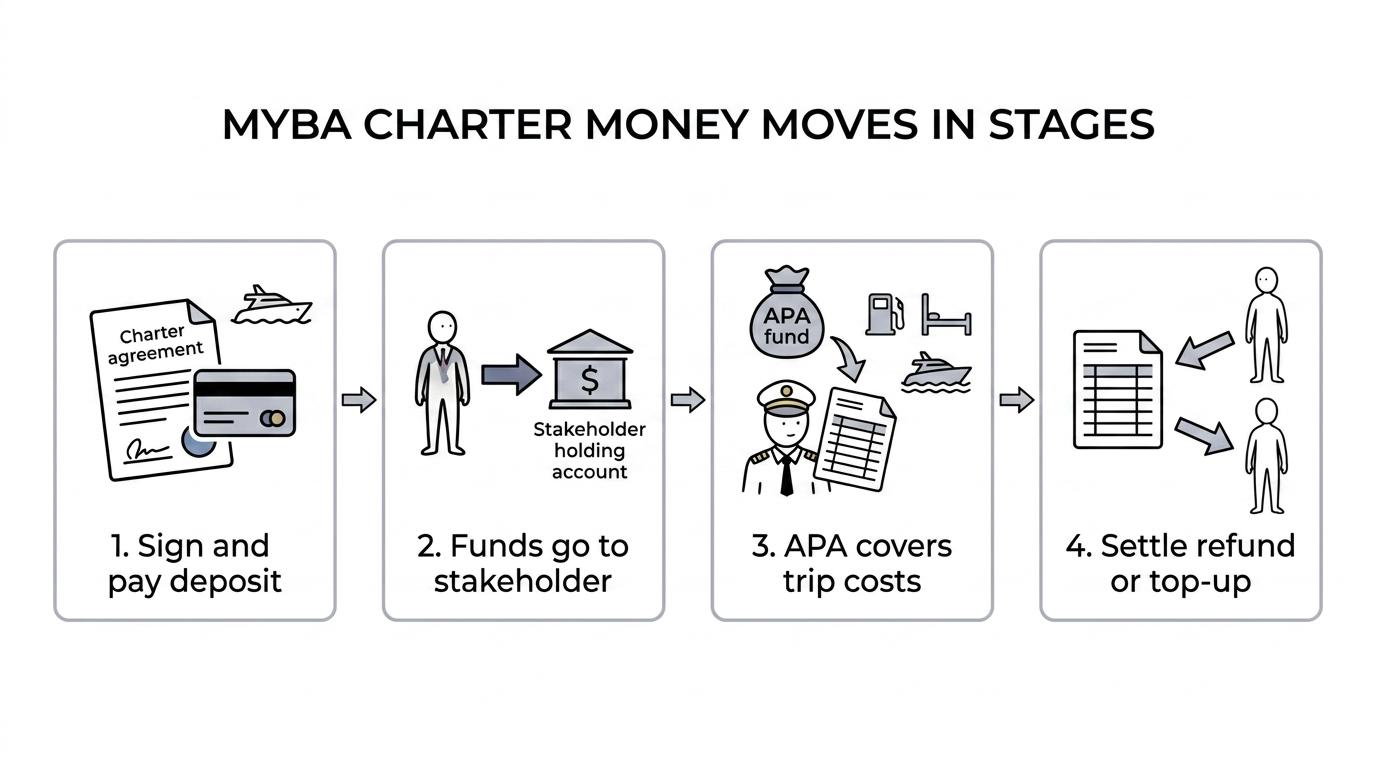
Clause 24 is also worth reading with clear eyes. Broker commission is earned on signature of the agreement and payment of deposit funds by the charterer. That does not mean the broker’s role is adverse to the charterer, but it does show that the contract’s commercial machinery starts turning early.
What the charter fee usually includes under the MYBA contract
Clause 8 gives a useful baseline for what is included in the charter fee. That fee covers the yacht itself, crew wages, crew uniforms, food, and the vessel and crew insurance stated in the agreement. Everything outside that package needs separate attention.
- Use of the yacht for the agreed charter period
- Crew wages and uniforms
- Food
- Stated vessel insurance
- Stated crew insurance
The temptation is to treat this list as broad enough to absorb most onboard spending. It rarely is. Fuel, berthing, communications, local charges, special requests, and itinerary-driven costs often sit outside the charter fee and are dealt with through the APA or other agreed payments.
APA, operating costs and stakeholder arrangements
The APA exists because a charter is a moving platform with variable costs. Clause 8 says the charterer must pay operating costs that are not included in the charter fee, and the captain must present a detailed APA expenditure account before disembarkation.
That accounting requirement is more than a formality. It creates a paper trail for spend during the trip and helps settle the balance at the end. If actual expenditure is lower than the APA advanced, the difference should be returned. If spend exceeds it, the charterer will usually need to top it up during or at the end of the charter, depending on the agreement and the way the cruise develops.
Small misunderstandings here can become expensive quickly.
MYBA charter agreement cancellation timelines and liquidated damages
Cancellation is one of the clearest examples of why the headline price does not tell the full story. Clause 11 allows the owner, if the charterer cancels before the charter period starts, to retain the first instalment paid after signature and any later instalments that have already become due.
The agreement then uses liquidated damages, which means pre-agreed compensation levels linked to how late the cancellation arrives. In practice, this creates a sliding scale of exposure rather than a vague argument about loss after the event.
- 30 days or more before commencement: liquidated damages are set at 25% of the charter fee.
- More than 14 days but less than 30 days: liquidated damages rise to 35% of the charter fee.
- 14 days or less before commencement: liquidated damages reach 50% of the charter fee.
That structure is commercially neat, but it can still catch people out. A charterer may assume that cancelling early enough means losing only a booking deposit. The form is more precise than that, and once instalments have fallen due the cash position can become difficult to reverse.
Delivery condition, cruising area and redelivery obligations
Clause 2 is one of the most charterer-friendly parts of the form because it is clear about the owner’s delivery obligation. The yacht must be delivered free of encumbrance, seaworthy, clean, in good condition, fully equipped, and ready for service.
That wording matters because it sets a standard, not a vague promise of best efforts. If the yacht is not in that condition, the charterer is not simply dealing with inconvenience. There may be contractual remedies in play.
Clause 4 then narrows how the yacht may be used. Cruising is restricted to the agreed cruising area, and time under way is limited to an average of six hours per day unless the captain agrees to exceed it. This is one of the most common sources of disappointment for first-time charterers who build an itinerary from a map rather than from the contract.
A glamorous route can look straightforward on paper and still be unrealistic within the agreed area, weather window, port schedule, and cruising-hour assumptions.
Clause 3 adds another point that deserves attention. Early redelivery by the charterer, before the charter period ends, does not entitle the charterer to any refund of the charter fee. In plain terms, coming off the yacht early does not make the week cheaper.
Disablement, breakdown and refund rights under the MYBA contract
Clause 12 is where the agreement becomes especially practical. It deals with disablement, meaning a period when the yacht cannot properly perform.
If disablement lasts between 12 and 48 consecutive hours, or up to one tenth of the charter period, whichever is shorter, the charterer is entitled to a pro rata refund unless the parties agree to continue on some other basis. That is a measured remedy. It does not assume every technical issue ruins the charter, but it does recognise that lost usable time has a value.
If disablement lasts more than 48 hours, or more than one tenth of the charter period, again whichever threshold the clause uses as the operative limit, the charterer may terminate by notice in writing.
That written notice point is easy to miss. In a stressful onboard situation, people tend to speak first and document later. The contract is more formal than that. If a termination right exists, it should be exercised in the way the agreement requires.
Common MYBA charter agreement pitfalls before signature
Most mistakes happen before anyone steps on board. As Peter Hejler Consulting documents in an analysis of common contract pitfalls in supplier agreements, preventable disputes often start with ambiguous payment triggers, undefined deliverables and weak notice mechanics—patterns that map closely to rushed charter bookings. They arise when the booking pace is fast, the yacht is popular, and the parties focus on securing dates rather than stress-testing the commercial detail.
For firms such as Nicholson, that is often where real value is created: identifying the clauses that affect cost, flexibility and remedies before the document becomes binding.
- Treating the charter fee as the full holiday budget
- Missing an instalment date
- Assuming unrestricted cruising hours
- Building an itinerary beyond the agreed cruising area
- Expecting a refund after voluntary early redelivery
- Leaving cancellation exposure untested
A more subtle pitfall is relying on habit. Repeat charterers sometimes assume that last year’s agreement, last year’s APA level, or last year’s cancellation expectations will carry over. MYBA says its documents are updated regularly, and even where wording changes look minor, the effect on a disputed point can still be meaningful.
Questions to raise before signing a MYBA charter agreement
A careful pre-signature review often prevents most of the friction that appears later. The best questions are not dramatic. They are specific.
- Which MYBA edition is being signed? Check the actual version, not a prior template or verbal summary.
- What is excluded from the charter fee? Ask for a clear list tied to the intended itinerary.
- What APA amount is proposed and why? The right figure depends on fuel burn, guest requests, berthing, and local charges.
- Who is the stakeholder? Know where funds are held and how payment confirmations will be handled.
- What are the instalment dates and cancellation consequences? Put them in a calendar the moment the agreement is signed.
- Does the planned itinerary fit the cruising area and average daily hours under way? If not, the issue should be fixed before signature, not onboard.
When those answers are clear, the agreement tends to feel less intimidating. It becomes what it is meant to be: a disciplined charter framework that protects expectations on both sides, with the biggest commercial risks visible from the start rather than surfacing halfway through the trip.