If you have spent time around commercial yacht paperwork, refit files, or older survey records, you have probably seen the term MCA LY3 appear again and again. It still carries weight in conversations about safety, certification, and operational standards, even though its formal place in the UK system changed several years ago.
For yacht owners, that matters because code references shape practical decisions. They affect how a yacht is presented for sale, how charter compliance is reviewed, how a refit brief is drafted, and how survey documentation is interpreted. The key point is simple: LY3 was once the main MCA code for large commercial yachts under 3,000 gross tonnage, but UK-registered yachts moved to the Red Ensign Group Yacht Code Part A from 1 January 2019.
What MCA LY3 means in yacht compliance
LY3 stands for the Large Commercial Yacht Code, version 3, issued by the UK’s Maritime and Coastguard Agency. It was the code of safe practice for large commercial yachts under 3,000 gross tonnage and set standards for how those yachts should be built, equipped, operated, examined, and certified.
That made LY3 far more than a technical booklet. In practice, it sat at the centre of commercial yacht compliance for a large part of the market, especially for yachts engaged in charter or other commercial use for sport or pleasure.
Its legal setting is also relevant. MCA guidance has stated that LY3 was published for the purposes of the Merchant Shipping (Vessels in Commercial Use for Sport or Pleasure) Regulations 1998. That link is why LY3 became such an important reference point across design, management, survey work, and operational planning.
After all, owners are not usually asking about LY3 out of academic interest. They are trying to answer very direct questions about whether a yacht can trade, what standards apply, and which code should govern current certification.
- Scope: large commercial yachts under 3,000 gross tonnage
- Focus: construction, equipment carriage, operation, examination
- Legal setting: Merchant Shipping (Vessels in Commercial Use for Sport or Pleasure) Regulations 1998
- Passenger limit: no more than 12 passengers
- historic compliance benchmark
Which yachts LY3 originally covered
LY3 did not apply to every yacht.
The code was aimed at large commercial yachts in commercial use for sport or pleasure. Official UK guidance describes this category as vessels 24 metres and over in load line length, or 150 gross tonnes or over if built before 21 July 1968, carrying no cargo and no more than 12 passengers.
That definition is worth pausing on because it draws a firm line between a privately operated yacht and a yacht in commercial service. A yacht might be similar in size, finish, and capability, yet fall into a different compliance path depending on how it is registered and operated.
For owners, this is often where confusion begins. A yacht may have been built to LY3 standards, advertised as LY3 compliant, or hold documentation rooted in LY3, while its current operational status points to a newer code or a different compliance framework altogether.
Why the Red Ensign Group Yacht Code replaced LY3
The biggest shift came on 1 January 2019, when the Red Ensign Group Yacht Code took effect for applicable UK-registered yachts. Official GOV.UK material states that this code superseded both LY2 and LY3.
That change matters because it turns LY3 into a legacy reference for much of today’s UK commercial yacht fleet. It remains important historically, and it may still appear in technical records, but it is no longer the current code for applicable UK-registered yachts.
The Red Ensign Group Yacht Code Part A was introduced with legal force for those yachts under the same 1998 Merchant Shipping regulations that had underpinned the earlier regime. GOV.UK also states that the Red Ensign Group code combined the large yacht code version 3 with the passenger yacht code. In other words, it was not a minor editorial update. It was a structural change in the way the code system was presented and applied.
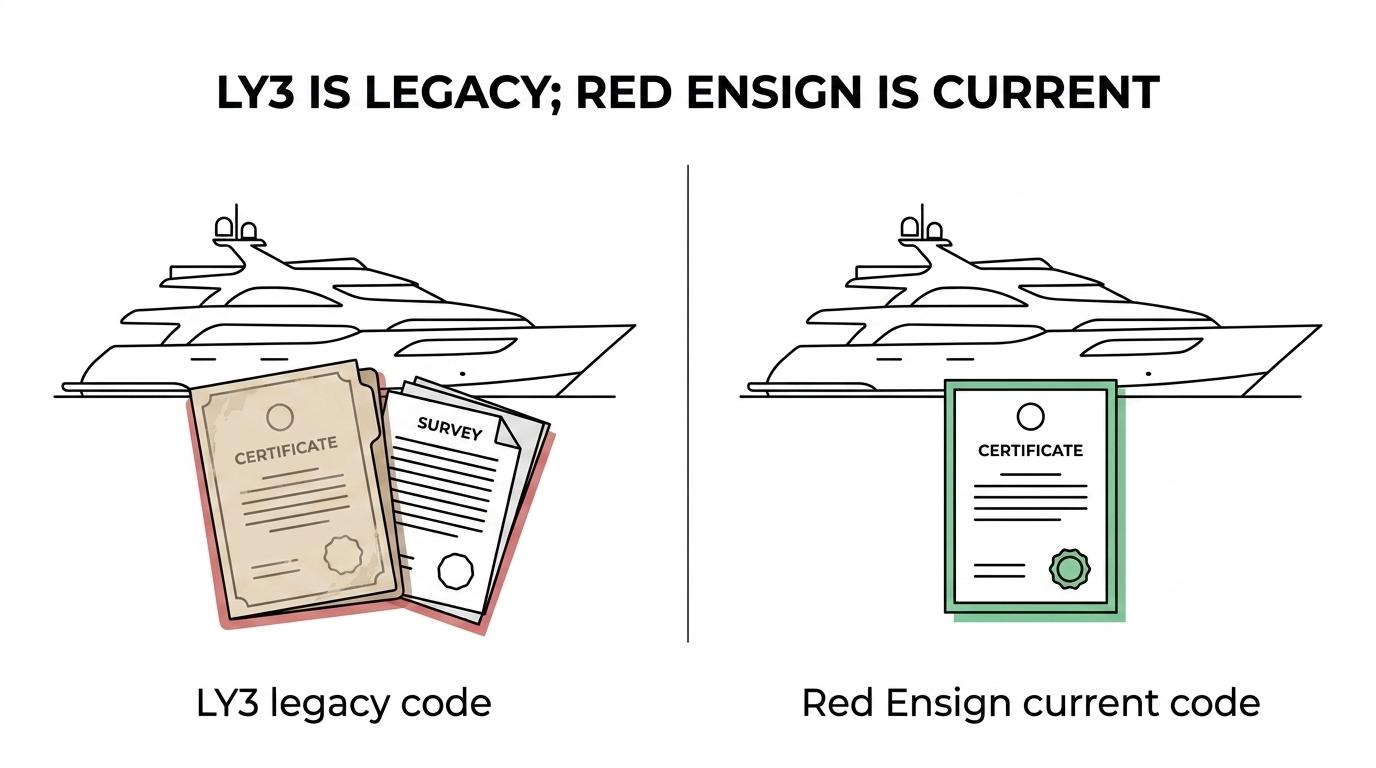
Here is the practical distinction:
| Topic | LY3 | Red Ensign Group Yacht Code Part A | |---|---|---| | Status | Previous MCA large commercial yacht code | Current code for applicable UK-registered yachts from 1 January 2019 | | Main use | Large commercial yachts under 3,000 gross tonnage | Current governing code in the UK framework for relevant yachts | | Legal position | Legacy code reference | Took legal force from 1 January 2019 | | Relationship to older codes | Version 3 of the Large Commercial Yacht Code | Supersedes LY2 and LY3 | | Owner takeaway | Review as historical compliance context | Use for present UK compliance assessment where applicable |
Why LY3 still appears in yacht documents
Even though LY3 was superseded, it has not vanished from the industry vocabulary.
That is normal. Yachts have long operational lives, and their documentation stacks are rarely reset from zero when a new code arrives. Build files, earlier surveys, equipment schedules, manuals, and refit specifications often carry forward earlier code references for years.
There is also a specific reason LY3 continues to surface in official material. GOV.UK guidance on life-saving equipment still references the Large Commercial Yacht Code for certain ships under 3,000 gross tonnage. So while LY3 is mainly a legacy compliance code, it remains visible in targeted guidance and in older regulatory pathways.
Owners commonly come across LY3 in:
- pre-2019 survey records
- original build specifications
- refit documentation
- life-saving equipment references
- sales due diligence files
That does not automatically signal a problem. It usually signals history.
What yacht owners should check when paperwork mentions LY3
When LY3 appears in a yacht’s file, the right response is not to assume the yacht is current, or non-current, on that basis alone. The better approach is to identify why LY3 is being mentioned and whether the reference is historical, technical, or still tied to an active certification trail.
Several points should be checked early in any review.
- Check the flag state and registration: for applicable UK-registered yachts, the Red Ensign Group Yacht Code Part A took effect from 1 January 2019 and superseded LY3.
- Review the certificate set: look at current commercial certificates, survey dates, and any statements that cross-reference old and new code requirements.
- Confirm the operating profile: commercial use, passenger numbers, gross tonnage, and load line length all affect which rules matter most.
- Inspect refit and equipment records: older systems may have been installed to LY3 criteria, while present approval may sit under the Red Ensign Group code.
- Match the paper trail to the intended programme: charter activity, cruising area, and owner use should all be consistent with the yacht’s certification basis.
This is where detail counts. A yacht may have a strong compliance history, yet still need careful cross-checking if the owner plans a change in charter use, a substantial refit, a change of flag, or a transaction that depends on clear certification language.
MCA LY3 and yacht sales, charter, and management decisions
For sales and purchase work, LY3 often appears as part of the yacht’s compliance story rather than as the final word on current eligibility. Buyers want to know whether the yacht was built to a recognised commercial standard, whether upgrades have been handled properly, and whether the present certification matches the marketing position.
For charter operations, the issue is even more immediate. A yacht offered commercially needs a current and coherent compliance basis. If an older brochure or specification sheet still says “LY3 compliant”, that wording may need to be checked against present certification under the Red Ensign Group framework.
Management teams also look at LY3 through a practical lens. They need to know what legacy standards shaped the yacht’s original construction, where equipment choices came from, and whether any later modifications created gaps between original code assumptions and present code requirements.
A well-run review usually asks three things at once:
- What standard was the yacht originally built to?
- What standard is the yacht operating under now?
- What standard will apply after the next material change?
That sequence helps owners avoid expensive surprises during a survey, a sale, or a charter season launch.
Key technical terms around LY3 that owners should know
A few terms appear again and again in LY3 and later code references, and owners benefit from being precise with them.
Gross tonnage is not a statement of weight. It is a measurement tied to the yacht’s internal volume and certification framework. When LY3 refers to yachts under 3,000 gross tonnage, that threshold is central to the scope of the code.
Load line length is also important because the large commercial yacht definition begins at 24 metres and over in load line length, with a separate provision for certain older vessels of 150 gross tonnes or more built before 21 July 1968.
Then there is the familiar 12-passenger limit. This is one of the clearest dividing lines in yacht regulation. Once a vessel moves beyond that level, it enters a different regulatory environment, with materially different design and certification implications.
Finally, surveying and certification are not box-ticking exercises. They are the mechanism by which code standards are tested against the yacht as she actually exists and operates.
How LY3 affects refit planning and technical upgrades
A refit can trigger knock-on questions about present code compliance, especially if the yacht’s use, layout, systems, or operational area is changing. If a yacht was originally built or coded under LY3, many technical choices on board may reflect that code’s structure and assumptions. Fire protection arrangements, life-saving appliances, stability documentation, operational manuals, and equipment carriage plans can all carry traces of the original framework.
That does not mean those arrangements are wrong. It means they should be reviewed in context. A refit can trigger knock-on questions about present code compliance, especially if the yacht’s use, layout, systems, or operational area is changing.
Owners can save time by asking early whether a planned upgrade is just a replacement in kind or a wider compliance event. The distinction is significant. A simple equipment renewal may be straightforward, while a major systems change can bring broader review requirements.
Teams with long industry experience, including Nicholson, generally treat LY3 references as part of a yacht’s technical and commercial history, then map them against the yacht’s current certification path. That method keeps the focus where it belongs: on what the yacht needs today, not only on what was correct when she was first coded.
Why clear code language matters in owner communications
One of the most useful steps an owner can take is to insist on precise wording in sales particulars, charter descriptions, management reports, and refit scopes.
“Built to LY3” is not the same as “currently coded under the applicable UK standard.” “Originally certified under LY3” is not the same as “presently compliant with all requirements relevant to the intended commercial programme.” Those distinctions may look subtle on paper, yet they make a real difference in due diligence.
That is why clear compliance language has value beyond regulation itself. It helps avoid delay, protects credibility in the market, and supports cleaner negotiations between owners, buyers, managers, captains, surveyors, and flag advisers.
For most owners today, LY3 is best viewed as an important part of the yacht’s regulatory history. The live question is whether that history has been properly carried forward into the yacht’s current code position under the system now in force.