Few buying decisions shape yacht ownership more than the choice between a one-off build and a yacht produced in series. It affects not only the look of the vessel, but also delivery timing, capital commitment, technical choices, resale positioning and the level of owner input from the first sketch onwards.
For some owners, only a fully personal yacht will do. Others want the confidence of a proven platform, a shorter wait, and a clearer path to the first season on the water. That is why the conversation is rarely just custom yachts versus production yachts. In practice, semi-custom yachts often sit in the middle and give buyers a highly attractive balance of freedom and efficiency.
What defines custom yachts
A full custom yacht begins with an owner brief, not a catalogue. The hull, naval architecture, exterior styling, interior arrangement and technical package are developed around a specific vision. In simple terms, it is a yacht built from the keel up for one owner.
That degree of freedom can be powerful. A custom yacht can be designed around family use, corporate entertaining, world cruising, charter ambitions, wellness spaces, toy storage, crew flow, or any mix of those priorities. If an owner wants a beach club configured in a very specific way, a distinctive profile, or a technical platform built around unusual range or performance goals, custom yachts make that possible.
Industry reporting in 2025 described fully custom superyachts as projects created from a near blank slate, tied to longer build cycles and significantly higher investment than semi-custom alternatives. That is not a drawback in itself. For many buyers, it is the point.
A full custom brief typically opens the door to:
- Maximum design freedom
- Owner-led layout planning
- Unique exterior identity
- Technical choices shaped around use
- Stronger emotional connection to the yacht
How production yachts differ from custom yachts
Production yachts are developed in series. The shipyard creates a model range with fixed engineering, known layouts, established supplier relationships and repeatable construction methods. Buyers select from an existing concept rather than building the whole yacht around a fresh brief.
This approach brings clear advantages. Delivery is usually faster. Costs are more predictable. Performance data are often based on earlier sisterships, which gives confidence around handling, maintenance and onboard systems. A buyer who wants to cruise soon, rather than spend years in design process and shipyard visits, may find that a production yacht is the most sensible answer.
There is also a commercial logic here. Production yachts allow builders to refine the same model repeatedly, which can improve quality control and shorten lead times. For many owners, that proven formula matters more than absolute uniqueness.
Yet the trade-off is obvious. Structural changes are limited, layout options are narrower, and the yacht will share its DNA with other vessels from the same series. If the brief is highly personal, the production path can start to feel restrictive quite quickly.
Why semi-custom yachts sit between custom yachts and production yachts
Semi-custom yachts deserve close attention because they answer the needs of a very large share of the market. They begin with a defined platform, often a tank-tested platform with established naval architecture and hull design, then give owners room to shape layout, décor, guest spaces and selected superstructure details.
That means buyers do not start from zero, but they are far from choosing a fixed product off the shelf. The result is a yacht with real personality, lower technical risk than a one-off concept, and a shorter build cycle than many full custom projects.
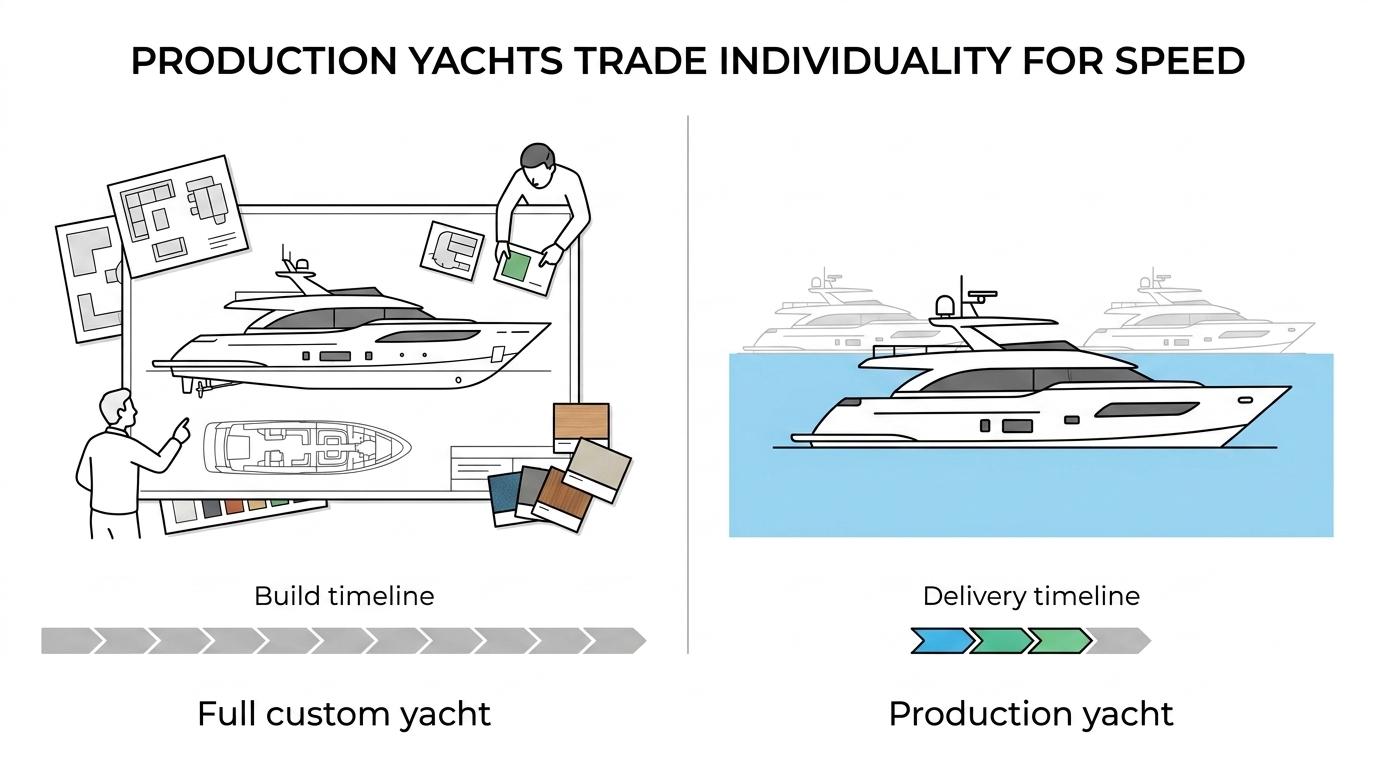
This middle ground is often where the conversation becomes most practical.
- Full custom: built to a single owner brief from keel to mast
- Semi-custom: based on a proven platform with owner choices on layout and finishes
- Production yacht: built in series with limited structural variation
Custom yachts vs production yachts: key comparison table
The broad differences become easier to judge when set side by side.
| Factor | Full custom yachts | Semi-custom yachts | Production yachts | |---|---|---|---| | Design freedom | Highest | High within a defined platform | Limited | | Build starting point | Blank-page owner brief | Existing hull and engineering base | Fixed model range | | Build cycle | Longest, often several years | Shorter than full custom | Fastest | | Cost | Highest entry point | Mid to high | Usually lowest of the three | | Technical risk | Higher due to one-off solutions | Lower than full custom | Lowest | | Owner involvement | Intensive | Moderate to high | Lower | | Delivery predictability | More variable | Better controlled | Most predictable | | Uniqueness | Complete individuality | Strong individuality | Shared series identity | | Resale appeal | Depends on design and specification | Often broad if well judged | Often broad due to market familiarity |
Cost, timing and design trade-offs in custom yachts
Time, more than almost any other factor, often decides the answer.
A large full custom yacht can require a build cycle of three to five years from contract to delivery, according to industry expert commentary in 2025. That timescale reflects the depth of the design process, engineering development, approvals, material decisions and one-off construction challenges that come with a yacht built specifically for one owner.
Semi-custom yachts tend to shorten that process because much of the naval architecture and engineering work has already been settled. Production yachts are faster again, especially when a hull is already under construction or available for quick completion. A buyer targeting a near-term Mediterranean or Caribbean season will naturally view this very differently from an owner planning a long-term family flagship.
The same pattern applies to budget. Full custom yachts bring the highest initial commitment because they involve unique design work, more extensive project management and fewer economies of repetition. Semi-custom yachts reduce some of that pressure. Production yachts usually offer the clearest upfront pricing, though options and owner upgrades can still move the figure sharply.
Cost should not be judged only by the contract price, though. A yacht that perfectly matches the owner’s intended use may provide better long-term satisfaction than a quicker, cheaper compromise. Equally, a series-built yacht that gets the family afloat sooner may be worth far more than a project that remains in planning for years.
Why demand for custom yachts remains strong
Despite the longer timetable and higher spend, demand for custom yachts remains notably robust. Recent market data point to a healthy order book and steady appetite for new builds above 30 metres.
Industry figures published in 2026 reported 215 new yachts over 30m sold in 2025, up from 200 in 2024. The same reporting stated that 641 yachts were in build in March 2026, with the 30-40m segment accounting for 39% of those projects. That matters because the 30-40m segment is often the entry point where owners seriously compare semi-custom and full custom solutions.
Another market report from early 2026 listed 1,093 projects in the Global Order Book, a rise of 3.9% on the prior year. Italian builders continued to dominate overall production volume, while the Netherlands, Turkey and Germany remained closely associated with larger, highly customised luxury projects. The message is clear: the market is not moving away from personal design. It is finding sharper ways to balance originality, efficiency and build capacity.
Technical priorities are shifting as well. Hybrid yachts still represent a relatively small share of the fleet, around 5% in one 2026 market outlook, yet owner interest in quieter operation, efficiency and updated energy systems is steadily shaping new-build conversations. Custom yachts, and to a lesser degree semi-custom yachts, give more room to integrate those ambitions early in the specification.
How buyers can choose between custom yachts and production yachts
The right choice depends less on status and more on fit. A custom yacht is not automatically “better” than a production yacht. It is better only when the owner truly values the freedoms it offers and is willing to commit the time, budget and attention the process demands.
A practical decision usually starts with a few direct questions:
- Use case: Will the yacht be centred on family cruising, charter revenue, long-range passages, entertaining, or a mix of all four?
- Timing: Is the owner happy to wait through a multi-year design and construction period, or is earlier delivery a priority?
- Design identity: Is a unique profile and tailored layout essential, or would a refined existing model satisfy the brief?
- Project involvement: Does the owner want regular input on design, systems and finishes, or would a lighter-touch process be preferable?
These questions often bring clarity very quickly. A buyer who wants a very specific beach club arrangement, unusual tender stowage and long-range cruising capability may be heading towards full custom. A buyer who wants a proven 35-metre platform with a personalised owner’s deck and selected interior changes may be better served by semi-custom. Someone seeking reliable, efficient delivery with limited complexity may prefer production yacht.
This is where experienced brokerage and new-build guidance become valuable. Nicholson can help frame the decision in commercial, technical and lifestyle terms, rather than treating it as a matter of prestige. The strongest results usually come when the yacht type matches the owner’s real priorities, not an abstract idea of what ownership should be.
Custom yachts will always hold a special place because they allow an owner to create something genuinely personal. Production yachts will always matter because they put owners on the water with speed, confidence and strong value. Between them, semi-custom yachts continue to prove why the middle ground is often where smart buying happens.