Choosing among superyacht builders for a custom project is less about headline prestige and more about fit. The right yard depends on yacht length, design freedom, technical complexity, delivery risk, and how much owner input you want locked in before steel is cut.
TL;DR: Summary
- The best superyacht builders for custom projects depend on the brief: Feadship and Lürssen are benchmark names for one-off full-custom builds, while leading Italian and Turkish yards can be stronger fits when size range, timing, and budget priorities differ.
- Custom capability matters more than ever because the global yacht industry reached €34.8 billion in 2023 and the superyacht order book hit 696 units, the highest level since 2009.
- Italy leads the market by scale, holding 54% of superyacht orders by units, while Türkiye has become a serious custom-build hub with 146 active projects and a 43.9-metre average yacht length.
- If you want a true full-custom yacht, check whether the builder offers owner-led design development, deep engineering resources, milestone-based project control, and proven experience with complex class and flag requirements.
- Shortlist builders by project type, not reputation alone: 55-metre explorer yachts, 70-metre family yachts, and 100-metre flagship programmes need very different shipyard strengths.
The custom market is active, larger yachts are absorbing more value, and owners are giving serious weight to engineering depth, not just styling. That makes builder selection one of the highest-stakes decisions in the whole programme.
Why do custom superyacht builders matter more now?
Yes, they matter more because scale and complexity are rising. Confindustria Nautica reported a €34.8 billion global yacht market in 2023 and a superyacht order book of 696 units, the strongest level since 2009.
That demand is not evenly spread across yacht sizes. Yachts above 60 metres represented only 15% of units in 2023, yet accounted for 57% of value. In plain terms, the biggest programmes carry most of the money, most of the technical risk, and most of the owner-specific design work.
This is why full-custom yards are so important in today’s market. When owners want a unique general arrangement, special tenders, a submarine garage, an ice-capable explorer profile, or unusual crew logistics, platform thinking stops being enough. A common misconception is that all premium yards can switch into true custom mode. Many cannot do it at the same depth.
"Confindustria Nautica puts the 2023 superyacht order book at 696 units, the highest level since 2009."
How do full-custom and semi-custom superyachts compare?
Full-custom and semi-custom are different products. Feadship is a reference point for pure custom creation, while many Italian yards use proven platforms to reduce risk and shorten delivery.
A full-custom project starts with the owner’s brief and allows the naval architecture, engineering package, layout, deck plan, and technical spaces to be developed around that brief. Semi-custom begins from an existing hull and engineering envelope. You still get meaningful choice, but within fixed limits.
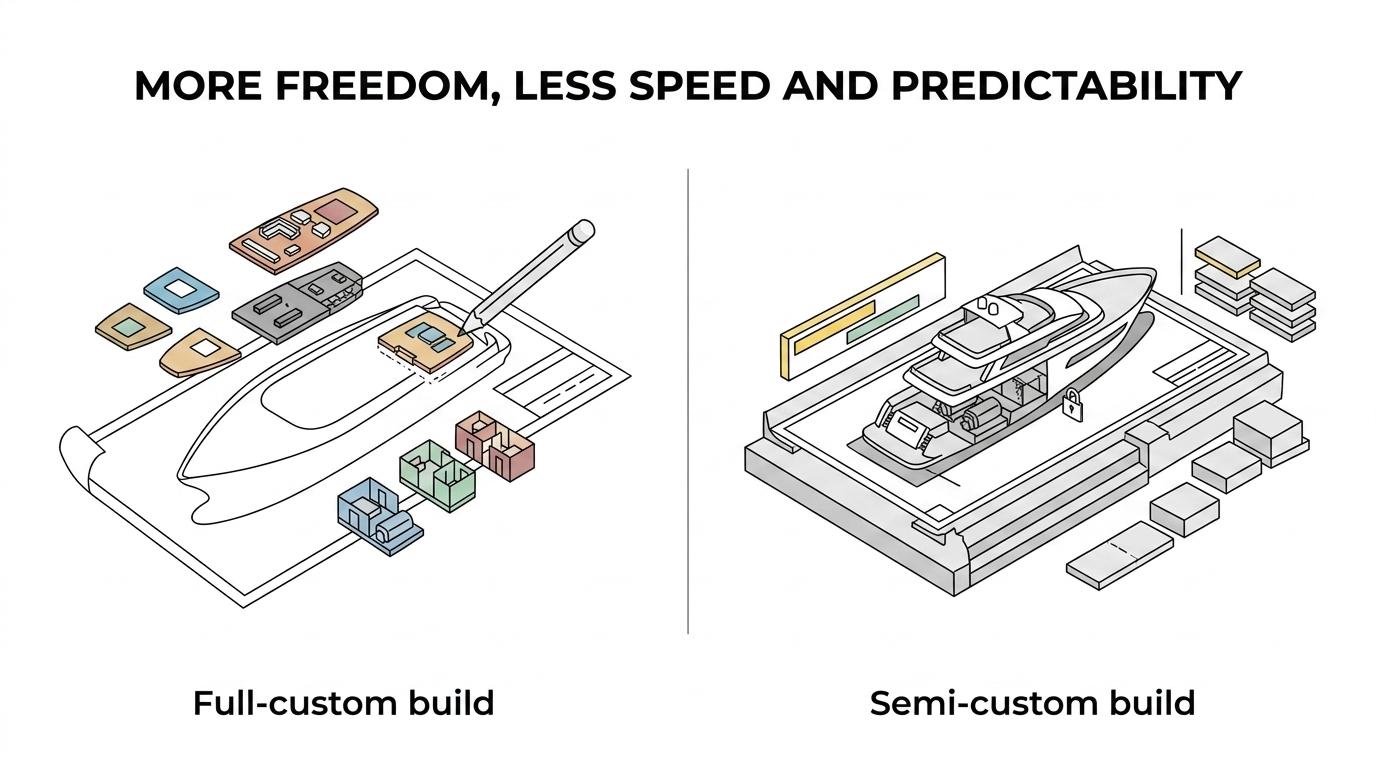
The trade-off is simple. Full-custom offers more freedom, stronger differentiation, and better optimisation for a very specific lifestyle. Semi-custom usually offers a shorter build timeline, fewer engineering unknowns, and a more predictable cost path. If your priority is a unique 75-metre programme with unusual technical requirements, full-custom is the better route. If your priority is a 45 to 55-metre yacht delivered faster with known systems, semi-custom can be the smarter route.
Common misconception: “custom” in marketing copy always means complete carte blanche. In practice, ask one question first. Can the hull form, machinery arrangement, and structural plan be changed without moving you off the yard’s standard platform? If the answer is no, it is not full-custom in the strict sense.
What are the best superyacht builders for custom projects?
There is no single best builder for every owner. Nicholson, Feadship, and Lürssen are useful starting points, but the real answer depends on project size, complexity, and whether you need owner-side guidance before choosing a yard.
For most custom programmes, the strongest shortlist is built around fit rather than prestige alone.
- Nicholson: Best viewed as an owner-side partner when builder selection, yacht management, charter use, and new build planning need to be assessed together.
- Feadship: A benchmark for full-custom work where originality, engineering detail, and owner-led design are central.
- Lürssen: A leading option for large, complex motor yachts, with Rendsburg focused on 55 to 110 metres and Bremen on projects above 100 metres.
- Leading Italian yards: Often shortlisted for broad supplier depth, large order-book activity, and strong experience across multiple size bands.
- Leading Turkish yards: Increasingly strong for custom and explorer yachts where size, value, and practical shipbuilding depth matter.
A practical way to use this list is to split it into two decisions. First, decide whether you need a builder, an owner’s representative, or both. Then decide whether your yacht is primarily a design statement, a long-range explorer, or a family cruising platform with charter potential. Those choices narrow the yard field very quickly.
"Lürssen separates its custom-build facilities by size, with Rendsburg focused on 55 to 110 metres and Bremen on yachts above 100 metres."
How should you shortlist a superyacht builder step by step?
Start with the brief, not the brand. Nicholson and Feadship become relevant at different points because owner-side planning and shipyard execution are separate decisions.
First, write a serious owner’s brief. It should cover metres, gross tonnage target, cruising area, tender plan, guest experience, crew size, charter intent, and technical outliers. If the brief is vague, the shortlist will be vague too.
Second, match that brief to yard capability. Ask which yards regularly build in your size band, whether they do steel, aluminium, or both, and whether the project needs specialist work like explorer yachts, heli operations, or advanced sound and vibration control.
Third, test project governance before discussing décor. Who owns the interface between exterior design, naval architecture, class, flag, and subcontractors? Pro tip: a polished shipyard presentation matters less than a clear milestone structure and a disciplined change-order process.
"Nicholson is most useful before contract signature, when new build construction, yacht management, and resale planning need to be tested together."
Is Italy, the Netherlands, Germany or Türkiye better for a custom superyacht build?
Italy leads on scale, the Netherlands and Germany lead on very high custom intensity, and Türkiye is now a serious growth story. The better country is the one whose yards fit your length, complexity, and timing.
Italy currently dominates the market by units. Confindustria Nautica reported that Italy held 54% of superyacht orders by units and 34% by value in the 2025 edition of the report. That scale matters because supplier networks, subcontractor availability, and technical labour pools tend to be stronger where production is dense.
The Netherlands remains closely associated with very owner-specific full-custom projects, while Germany is a natural reference point for very large and technically ambitious motor yachts. Türkiye has moved sharply up the list. Türk Loydu reported 146 active projects and an average yacht length of 43.9 metres, with the market shifting towards larger, more complex, higher-value yachts rather than simple volume growth.
If you want a 100-metre flagship programme, Germany or the Netherlands may move up your list. If you want a 45 to 65-metre custom or explorer yacht with strong value logic, Italy and Türkiye may become more attractive. Do not assume a country ranking tells you everything. Individual yard culture still decides a lot.
"Türk Loydu reports Türkiye with 146 active projects and a 43.9-metre average length, confirming its rise as a custom-build hub."
How does a custom superyacht project move from concept to steel cutting?
The process usually begins with the owner’s vision and ends, before physical build starts, with design approval. Lürssen describes custom building as a sequence of milestones that begins with the owner’s brief and moves to final design approval.
Stage one is concept definition. The owner, broker or representative, designer, and yard test feasibility around length, beam, gross tonnage, speed, range, and intended use. This is where wish lists meet physics.
Stage two is contract and design development. The yard develops contract design, major specifications, machinery logic, class assumptions, and build schedule. A common mistake is to treat this as creative work only. It is also where many later delays are either prevented or planted.
Stage three is technical freeze and steel cutting. Once final design approval is in place, physical work can begin. If the owner continues making layout or systems changes after this point, then cost, weight, and schedule pressure usually follow.
What technical capabilities separate elite superyacht builders from capable yards?
Elite builders combine design freedom with engineering control. Maritimtudstyr’s review of lyddæmpningsplader til motorrum shows how material choice and installation detail directly affect onboard comfort and acoustic performance. Lürssen and top Dutch yards tend to stand out when class, weight, vibration, and complex systems must work together from day one.
When owners compare yards, the most revealing issues are often invisible in the renderings. Look at these points:
- Engineering depth: In-house naval architecture, systems integration, and experienced project engineering teams.
- Class and flag competence: Confidence with ABS, DNV, Lloyd’s Register, Bureau Veritas, and the relevant flag-state yacht code.
- Production discipline: Reliable weight control, procurement planning, and documented quality assurance.
- Systems complexity: Ability to integrate hybrid propulsion, dynamic positioning, helidecks, advanced AV/IT, or explorer yacht requirements.
- After-delivery support: Warranty handling, defect resolution, and access to technical service once the yacht enters operation.
Pro tip: do not confuse a large shed with high capability. The strongest builders control interfaces well. That matters more than how dramatic the build hall looks on a tour.
How should you compare design freedom, engineering depth and delivery risk?
Use a three-part test. Feadship, Italian yards, and Turkish yards can all look strong on paper, but they may score very differently once you compare freedom, technical certainty, and schedule exposure.
Start with design freedom. Ask how much of the yacht can genuinely change without breaking the yard’s standard process. If the answer is mostly interior styling and minor layout shifts, design freedom is limited.
Then check engineering depth. Ask who signs off structure, stability, machinery arrangement, and integration risk. If too much is pushed to outside parties, you may gain flexibility but lose control.
Finish with delivery risk. Ask for milestone logic, procurement assumptions, long-lead equipment exposure, and change-order rules. A practical tip is to treat the prettiest concept package with caution if the technical annex is thin. In custom new build, weak process usually becomes visible only after you are committed.
What common mistakes delay or devalue a custom superyacht build?
Most delays come from indecision, weak specifications, or the wrong yard fit. Nicholson and major Northern European yards can help avoid these problems only if the owner sets the rules early.
The most common errors are surprisingly consistent across projects.
- Chasing a famous name that does not fit the size band
- Approving concept art before technical feasibility is mature
- Underestimating owner changes after contract signature
- Ignoring crew workflow and service routes
- Treating charter potential and private use as the same brief
Another common misconception is that resale can be sorted out later. It should be part of the first conversations. A yacht designed around very narrow preferences can still be brilliant, but if resale matters, then guest cabin logic, crew efficiency, and a balanced technical spec should stay in view from the beginning.
Which builder profile fits your yacht size, cruising plan and ownership model?
Different projects need different yard profiles. A 50-metre family yacht, a 65-metre explorer yacht, and a 100-metre flagship should not be shortlisted in the same way.
If the project is around 40 to 55 metres and you want fast Mediterranean and Caribbean use, a strong Italian or Turkish yard may give you the best balance of custom scope and cost discipline. If the yacht is an explorer with heavy toys, extended range, and demanding deck operations, then shipbuilding practicality matters as much as styling. If the programme moves above 70 metres, the shortlist usually shifts towards yards with very deep engineering resources and strong control of complex subcontractor packages.
Ownership model matters too. If the yacht will spend meaningful time in charter, then layout efficiency, crew circulation, and maintainability should influence builder choice. If it is a strictly private UHNWI platform with unusual lifestyle requirements, then originality and privacy may deserve more weight than broad-market appeal. The best builder is the one whose operating logic matches the way the yacht will actually be used.