The best explorer yachts under 50m are the ones that can stay away from port longer, carry more equipment, and still deliver a refined onboard experience. In this bracket, the strongest options are defined by range, shallow draft, storage, deck utility, and operational self-sufficiency rather than speed alone.
TL;DR: Summary
- The best explorer yachts under 50m combine long-range cruising, expedition utility, and luxury living, with leading examples including the Baglietto X50, ICON MISSION-M, Sunreef 50M Sunreef Explorer, JFA’s full-custom 50m hybrid explorer, and the converted Kudanil Explorer.
- Buyers should prioritise mission profile first: range, draft, crane capacity, tender storage, guest count, and provisioning space matter more than top speed on a true explorer yacht.
- The standout technical benchmark in this group is ICON’s MISSION-M, which is described with a 7,000nm range, Ice Class 1D certification, Polar Code C rating, and a 9.6-ton crane with 15-metre reach.
- The standout catamaran concept is the 50M Sunreef Explorer, which pairs shallow draft and a 14.3-metre beam with long-duration autonomy, large storage, and guest-focused amenities for extended cruising.
- If you want lower technical risk and cleaner layout logic, choose a purpose-built new build like the Baglietto X50; if you want volume, character, and expedition pedigree, a converted vessel like Kudanil Explorer can be compelling but needs stricter due diligence.
- In this size band, “best” rarely means fastest. It usually means the yacht that can carry tenders, toys, provisions, crew, and guests comfortably across long passages with minimal compromise.
Strictly speaking, several of the most discussed models sit at 50m exactly rather than below it, yet they belong in the same buyer conversation because the market often treats this as the 50 metres-and-under segment. That is why the current field includes semi-custom monohulls, custom hybrids, catamaran explorers, and converted expedition vessels with very different strengths.
What makes an explorer yacht genuinely “best” under 50m?
The best under-50m explorer yachts prioritise range, storage, and operating logic over speed. ICON’s MISSION-M and Baglietto’s X50 show the pattern clearly: serious passage-making ability, useful deck space, and guest comfort in one package.
A rugged profile alone is not enough. A real explorer yacht needs room for tenders, toys, spare parts, and provisions, plus crew circulation that still works after two weeks at sea. If the aft deck looks impressive but cannot launch equipment efficiently, or if guest areas overwhelm storage, the yacht is not truly expedition-ready.
A common misconception is that “explorer” simply means a bold exterior and long bow. In practice, the best boats in this class are judged by autonomy, deck load capability, draft, redundancy, and how calmly they support life onboard when the nearest service port is not around the corner.
"Nicholson assesses explorer yachts across sales, charter, management and new build construction, which is why deck utility and operating logic matter as much as styling."
Why does the 50m threshold matter for explorer yacht buyers?
The 50m threshold matters because Baglietto’s 49.9-metre X50 and the 50M Sunreef Explorer sit at the point where serious expedition capability becomes possible without moving fully into ship-scale ownership.
Below this line, owners can still access a broad mix of cruising areas and marina options while gaining meaningful range, crew accommodation, and toy capacity. Move much larger, and every decision tends to become heavier: build complexity, systems integration, crew structure, and lifecycle cost all rise.
Pro tip: do not treat length overall as the whole story. A 49.9-metre yacht with a wide beam, heavy-duty crane, and expedition storage can be more capable than a longer yacht built mainly for Mediterranean hopping. Beam, gross volume, draft, and deck use often tell you more than length alone.
What are the best explorer yachts under 50m right now?
The strongest current names are Baglietto, ICON, Sunreef, JFA, and Kudanil Explorer. Each represents a different answer to the same brief: long-range cruising with genuine utility and liveability.
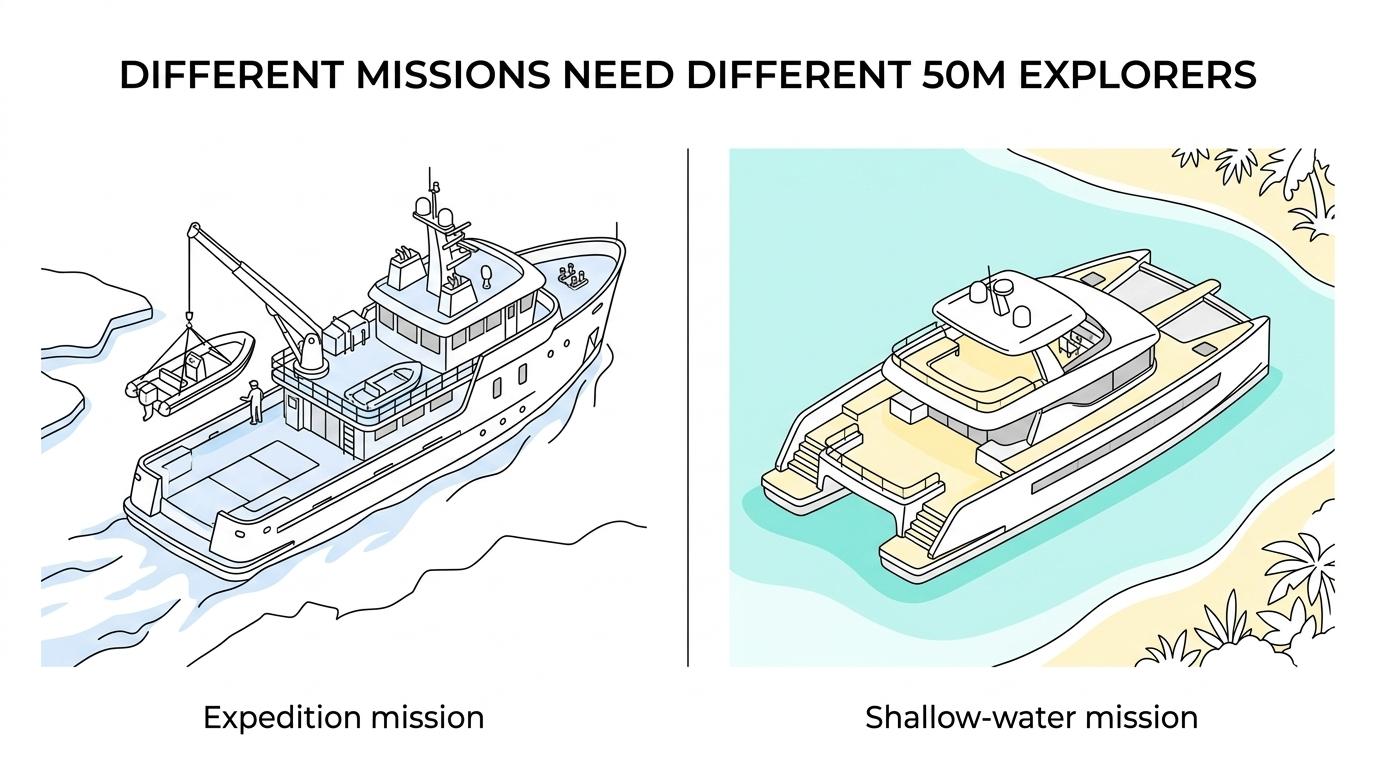
The list below is not a pure ranking of resale value or luxury finish. It is a practical shortlist based on how convincingly each yacht addresses the explorer brief in this size category.
-
Baglietto X50
Revealed in February 2024, the X50 is a 49.9-metre semi-custom explorer developed with Francesco Paszkowski. It looks especially strong for buyers who want purpose-built explorer styling and long-range intent without giving up the structure and predictability of a modern series platform. -
ICON MISSION-M
MISSION-M is presented on ICON’s 50 technical platform and is one of the most serious technical propositions in the segment. Its stated 7,000nm range, Ice Class 1D certification, Polar Code C rating, and 9.6-ton crane with 15-metre reach make it a benchmark for owners thinking beyond fair-weather cruising. -
50M Sunreef Explorer
Sunreef’s catamaran approach is one of the most distinctive ideas in the category. The model is described as self-sufficient for extended periods at sea, with shallow draft, major storage capacity, a full-beam aft cockpit, and an aft deck using the whole 14.3-metre beam. -
JFA’s full-custom 50m hybrid explorer
JFA’s recently launched full-custom 50m hybrid explorer stands out for buyers who want a family-oriented long-range platform and custom engineering. It is one of the clearest signals that hybrid propulsion is moving from concept language into real explorer builds. -
Kudanil Explorer
Delivered by Teraoka Shipyard in 1978 and refit in 2018, Kudanil Explorer represents the converted expedition route. With a 12.5m beam, 3.2m draft, 1,000 GT, and accommodation for 16 guests in 8 cabins, it offers scale and personality that many new builds under 50m cannot replicate.
Is a monohull or catamaran explorer better under 50m?
A monohull is usually better for heavy-duty expedition tasks, while a catamaran is often better for beam, shallow draft, and deck area. ICON and Sunreef make that contrast easy to see.
If your programme includes serious lifting gear, ice-class ambitions, or rougher high-latitude passages, a monohull usually feels like the more natural tool. Weight concentration, technical spaces, and deck equipment integration often fit the platform more easily.
If your priority is stability at anchor, expansive exterior living, and access to shallower anchorages, a catamaran explorer can be very attractive. The 50M Sunreef Explorer is a good example because its 14.3-metre beam is not just about entertaining. It also changes storage, guest flow, and deck flexibility.
A frequent misconception is that catamarans are only leisure-led choices. In reality, shallow draft and wide working deck space can be highly practical in remote cruising, provided the owner’s mission does not demand ice-class structure or heavy commercial-style deck operations.
Should you choose a new-build explorer or a converted expedition yacht?
A new build is usually the cleaner choice, while a converted vessel like Kudanil Explorer can offer rare volume and character. Baglietto and Kudanil sit at opposite ends of that decision.
Converted expedition yachts can be brilliant if you value internal volume, proven seakeeping, and a distinctive story. Yet the trade-off is technical due diligence. A beautiful refit does not remove the need to inspect steel condition, machinery age, class history, compliance work, and the standard of previous structural modifications.
Purpose-built explorer yachts tend to win on layout coherence, technical efficiency, and future serviceability. Tankage, tender storage, crew routes, and hotel systems can be planned from the keel up. That matters because long-range comfort often depends on mundane details like laundry workflow, freezer capacity, and noise isolation.
Converted expedition yachts can be brilliant if you value internal volume, proven seakeeping, and a distinctive story. Yet the trade-off is technical due diligence. A beautiful refit does not remove the need to inspect steel condition, machinery age, class history, compliance work, and the standard of previous structural modifications.
"Nicholson treats a converted explorer as a technical asset first, because management, refit history and future running plans shape value."
How should you define your mission profile before choosing an explorer yacht?
Start with use case, not aesthetics. JFA and Sunreef show how the same 50m envelope can serve very different owner goals.
Step 1 is geography. If your real plan is the Bahamas, East Mediterranean, and island groups with shallower approaches, draft becomes a deciding factor early. If your plan includes colder regions or longer unsupported passages, then range, class, and deck equipment move higher up the list.
Step 2 is operational style. If you want to carry large tenders, dive gear, and months of provisions, your aft deck needs to behave like a working platform. If you mainly want family cruising with comfort at anchor, guest space and beach-club logic may matter more than crane reach.
Step 3 is ownership model. If charter matters, cabin mix, outdoor social areas, and visual impact start to matter more. If private family use dominates, you may accept less flash in exchange for calmer crew flow and better storage.
Pro tip: build the yacht around your 80 per cent itinerary, not your fantasy one-off voyage.
How do you compare range, draft and deck utility step by step?
Compare range first, draft second, and deck function third. MISSION-M and Kudanil Explorer show why those three variables shape real-world capability more than marketing labels do.
Step 1 is to set a minimum range for your intended loops. If you want true ocean-crossing confidence, a yacht like MISSION-M with a stated 7,000nm range sits in a very different class from a yacht designed mainly for shorter seasonal hops.
Step 2 is to check draft against where you actually want to anchor. Sunreef’s emphasis on shallow draft matters because it changes where the yacht can go and how close the yacht can sit to shore in many cruising grounds. A yacht can have huge volume, but if its draft limits access, your use case narrows quickly.
Step 3 is to stress-test the deck plan. Ask a simple question: once tenders, toys, provisions, and guest furniture are all onboard, does the deck still work? ICON’s published crane capacity and reach are useful because they turn “expedition capable” into something measurable.
Are hybrid and electric explorer yachts practical under 50m?
Yes, but only when the mission matches the system. JFA’s hybrid explorer and Sunreef’s electric-led concept point to a credible shift, not a one-size-fits-all answer.
Hybrid and electric features can improve at-anchor comfort, reduce generator dependency in certain operating modes, and support a quieter onboard experience. For context, Wijnklimaatkasten’s guide to sound levels in dB is a useful primer on how manufacturers measure and compare appliance noise, a nuance that also matters when you read HVAC and generator specs. They also fit the explorer brief when owners want longer stays away from busy ports and lower local impact in sensitive cruising grounds.
The caution is straightforward. Remote cruising still depends on energy management, redundancy, support access, and honest expectations about hotel loads. If a yacht promises extraordinary autonomy, ask how that autonomy is achieved: fuel, batteries, solar input, load control, or a mix of all four. Sunreef’s solar-integrated concept is compelling, but the route plan still needs to match the energy profile.
"Nicholson sees hybrid explorer projects as strongest when the ownership brief, charter use and management plan are set before the build specification."
How should you inspect a converted expedition yacht before buying?
Inspect the technical record before the lifestyle finish. Kudanil Explorer proves why an impressive volume figure is only the start of the conversation.
Step 1 is paperwork. Review class status, refit invoices, yard records, flag compliance, and survey history. A refit in 2018 is useful context, but what matters is what was actually renewed, tested, or upgraded.
Step 2 is structure and machinery. Check hull condition, corrosion management, shaft lines, generators, HVAC, stabilisation, and tank systems. If the yacht began life as a commercial or expedition vessel, then conversion quality matters as much as original pedigree.
Step 3 is liveability. Walk the yacht as if you are provisioning for several weeks, not just attending a showing. A common mistake is to focus on saloon finish while missing crew workflow, cold storage, guest-to-crew separation, and the practical burden of maintaining older systems.
Which under-50m explorer yacht fits different owner profiles?
Different owners need different answers. Baglietto, ICON, Sunreef, JFA, and Kudanil each fit a distinct profile rather than serving as interchangeable “best” choices.
The right yacht depends on whether you care most about technical range, shallow-water access, full customisation, or converted-ship character. That is why shortlisting by profile is often more useful than shortlisting by brand alone.
- Semi-custom buyer: Baglietto X50 suits owners who want a fresh 49.9-metre platform with modern explorer identity and fewer unknowns than a one-off conversion.
- Technical expedition brief: ICON MISSION-M suits owners who care about 7,000nm range, Ice Class 1D, Polar Code C, and measurable deck utility.
- Shallow-draft luxury explorer: 50M Sunreef Explorer suits owners who want catamaran beam, major outdoor living, large storage, and long-duration autonomy.
- Custom hybrid family platform: JFA’s 50m hybrid explorer suits owners who want a tailored long-range yacht with newer propulsion thinking.
- Volume-led converted vessel: Kudanil Explorer suits owners who value 1,000 GT, 16-guest capacity, and expedition heritage enough to accept deeper due diligence.
If you are choosing within this bracket, the sharpest move is to decide what kind of explorer you want to be before comparing brochures. In this market, the best yacht is usually the one whose design logic matches your cruising reality.