Private ownership rewards a different catamaran choice than charter or occasional holiday use. The right boat is usually not the biggest or the most fashionable, but the one that fits your handling style, cruising plan and long-term operational demands.
TL;DR: Summary
- For most private owners, the best catamaran to buy is a cruising model in the 45 to 52 foot range, usually an owner-version sailing catamaran for efficiency or a cruising-focused power catamaran if speed and easy motoring matter more.
- Current buyer guidance converges on 45 to 48 feet for couples cruising full-time and about 48 to 52 feet for a family of four, because this size band balances liveaboard space, shallow draft, owner handling and running costs.
- Layout matters as much as length: owner versions suit private use better than charter-heavy four, five or six-cabin layouts unless you need frequent guest accommodation or future charter income.
- There is no single best catamaran for everyone. Cruising World notes the trade-off clearly: load carrying, performance and layout pull against each other, so the best choice depends on how you will actually use the boat.
- In the current market, broad U.S. new-boat demand has softened, but NMMA reported the yacht segment still grew 1.8% over a rolling 12-month period, which means private buyers may find more negotiating room in some areas without assuming premium yachts are suddenly cheap.
- Practical benchmarks include mid-40s to low-50s sailing cats for owner cruising, the Aquila 50 Yacht for power cruising with a three or four stateroom layout, and specialised power cats like the Invincible 38 only when speed and range matter more than liveaboard comfort.
That makes catamaran sales less about chasing a universal “best boat” and more about matching a design to a private ownership profile. If you buy with that lens first, the shortlist becomes much clearer.
What size catamaran is best for private ownership?
For most buyers, 45 to 52 feet is the sweet spot. Catamarans.com and Cruising World both support this band because it gives private owners real liveaboard volume without pushing handling, berthing and operating costs into a very different category.
For a couple planning extended cruising, 45 to 48 feet is usually the most efficient answer. You get meaningful storage, separate sleeping and utility zones, and enough deck area for anchoring life to feel easy rather than cramped. For a family of four, about 48 to 52 feet often works better because the extra volume helps with provisioning, privacy and water toys.
The common mistake is assuming another five feet always improves the ownership experience. It often improves comfort, but it can also raise dockage, maintenance access complexity, insurance exposure and crew expectations. If you want owner sailing rather than semi-professional operation, size discipline matters.
"Nicholson covers yacht sales, charter, management, and new build construction, which helps private buyers assess a catamaran as both an ownership asset and an operating platform."
Should you buy a sailing catamaran or a power catamaran?
A sailing catamaran is usually the better private ownership choice, while an Aquila 50 Yacht suits buyers who value predictable motoring and faster passage times. The right answer turns on your itinerary, fuel tolerance and willingness to handle sails.
If your plan is long-range cruising with weeks at anchor, a sailing catamaran usually wins. It cuts fuel dependency, supports slower and cheaper passagemaking, and still delivers the shallow draft and platform stability that draw many owners to catamarans in the first place. Owner-sailing couples often prefer this format because the boat works well even when the pace is unhurried.
If your plan is short seasonal cruising, island hopping on schedule, or entertaining guests who care more about air-conditioned comfort than sail trim, a power catamaran may be a stronger fit. Boat Trader describes the Aquila 50 Yacht as a cruising-focused power cat with either three staterooms and three heads or an optional four stateroom, four head layout. It also cites about 18 knots cruising speed and 422 gallons of fuel capacity, which tells you immediately what sort of ownership profile it serves.
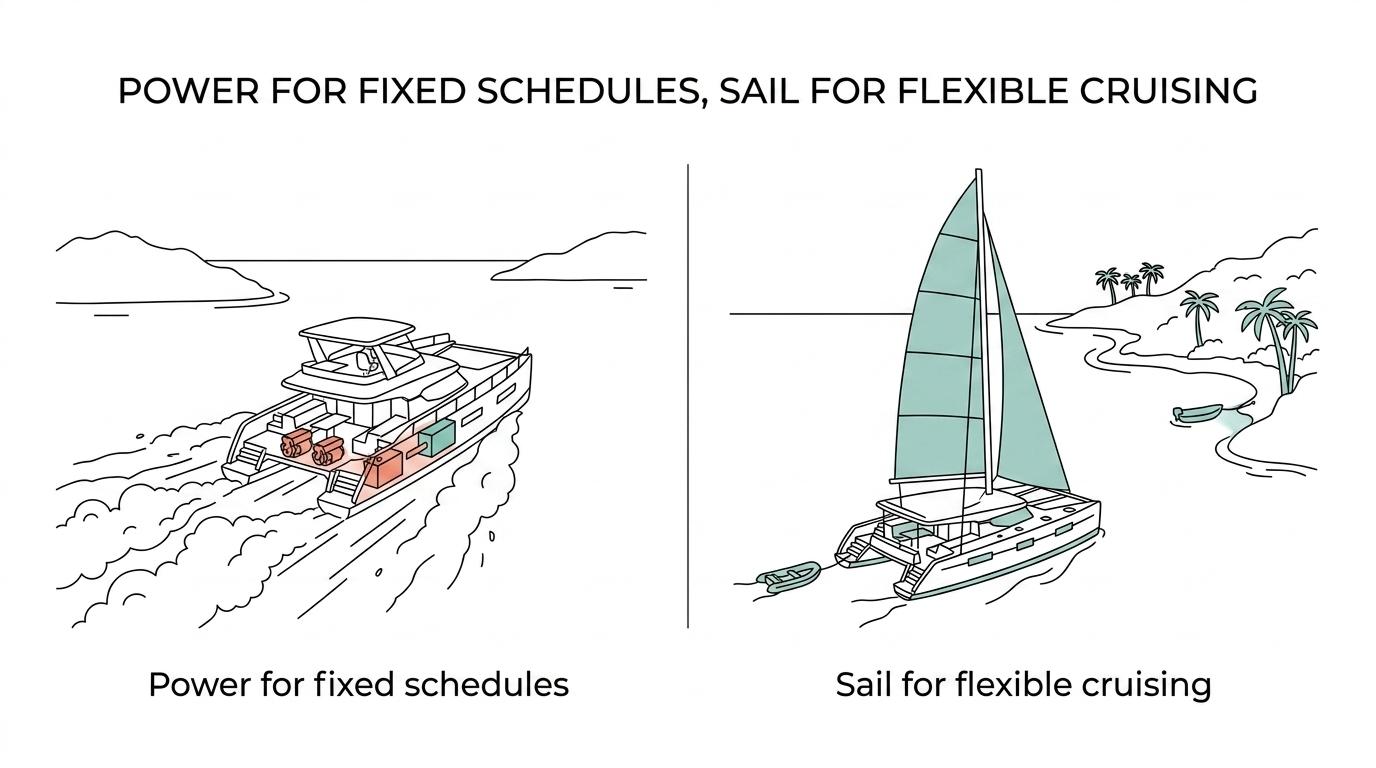
A useful rule is simple: if your calendar is fixed, power reduces friction; if your time is flexible, sail reduces cost. A second misconception is that power cats are automatically easier to own. They are easier in some manoeuvres, but fuel burn, mechanical systems and service schedules become more central.
"Nicholson specialises in luxury yacht sales and yacht management, which is relevant when a buyer needs to compare acquisition decisions with long-term operational demands."
What catamaran sales routes are best for private ownership?
The best route is usually specialist brokerage first, then late-model resale or factory-new order depending on your budget and timing. Private buyers get the best outcomes when the sales path matches their technical confidence and intended use.
Most buyers do better when they start with route selection before they start with brand selection. That sounds less exciting, but it saves time and money because the same 48-foot catamaran can look very different as a new build, a late-model brokerage boat, or an ex-charter refit project.
- Specialist brokerage, including Nicholson: Best for buyers who want layout guidance, market comparison and a realistic view of resale, charter potential and management implications.
- Late-model brokerage resale: Often the strongest value point because early depreciation has usually passed and the maintenance history can be checked.
- Factory-new order: Best if you want specific options, warranty coverage and a known baseline, but lead times and price discipline matter.
- Ex-charter purchase: Works if budget is tight and you plan a refit, but cabin-heavy layouts and deferred wear can change the real cost.
- Private direct sale: Can be attractive on price, though the burden of due diligence shifts much more heavily to the buyer.
What layouts work best for couples, families and guests?
Owner-version layouts are usually best for private ownership. Cruising World and Boat Trader both point to the same reality: cabin count changes how a catamaran lives, stores gear and carries people.
A private owner should usually prioritise usable daily space over maximum berth count. Charter-oriented cats often push four, five or six cabins because the revenue model rewards heads-in-beds. A private owner usually benefits more from a larger owner suite, better galley flow, dedicated workshop or utility space, and easier storage for spares and provisions.
Use this layout logic before you compare brands:
- Owner version: One hull or large section dedicated to the owner, with better storage and fewer compromises.
- Family layout: Three or four cabins with enough separation for children and guests without losing utility space.
- Charter layout: Higher cabin count, more heads, stronger guest flexibility, but less room for personal gear and long-term living.
If you expect frequent guests, do not assume a pure owner version is always ideal. If guests come for two weeks a year, owner space should still win. If guests come every month, a balanced three or four cabin arrangement may prove smarter.
How do you shortlist catamarans for liveaboard cruising?
Start with the cruising plan, then set the size band, then reject layouts that do not support daily life. That sequence works better than beginning with brand names like Lagoon or Bali and trying to justify them afterwards.
Step 1 is to define your operating profile in plain terms. Are you doing Mediterranean summers, Caribbean seasons, or multi-year ocean cruising? If the boat will spend long periods at anchor, water capacity, solar space, refrigeration volume and davit practicality matter more than headline speed.
Step 2 is to fix the size range before you step aboard too many boats. For most private owners, that means holding the line around 45 to 52 feet. This is the stage where many buyers lose focus, because a visually impressive 60-footer can distort expectations very quickly.
Step 3 is to build a shortlist around non-negotiables. These often include owner suite arrangement, engine access, bridge deck clearance, sail plan simplicity, tender handling and storage. If a boat fails two or three of those points, it should drop off the list even if the styling is attractive.
"Nicholson’s focus on sales, charter, management, and new build makes it useful when an owner wants one catamaran to work for private use now and different operating goals later."
How do running costs change as catamaran length increases?
Running costs rise sharply with length, and the U.S. Department of Transportation cost model for a 78-foot catamaran shows why. Maintenance and marine hull insurance are separate line items because size changes both technical workload and financial exposure.
Once you move beyond the mid-size owner range, the boat stops scaling gently. More length usually means higher marina costs, bigger sails or engines, more complex electrical systems, larger haul-out requirements and greater parts inventory. The jump is not only in quantity but in service difficulty.
A common misconception is that two hulls simply mean double the cost of a monohull. The real picture is more nuanced. Some systems are duplicated, some spaces are easier to access, and some operating costs come from stability and shallow draft. Still, from about 55 feet upward, the ownership profile often changes from practical private operation to something closer to managed operation.
If you are cost-sensitive, treat every extra foot as a systems question, not just a comfort question.
Should you buy new or used in the current catamaran sales market?
Used is usually the smarter private ownership buy, while new suits buyers who value specification control and warranty. NMMA data shows softer overall boat demand, but premium yacht behaviour is different enough that buyers should stay selective.
NMMA reported year-to-date new powerboat retail unit sales of 130,956, down 9.7% against the same six-month period in 2024. It also reported rolling 12-month retail powerboat sales down 7.3% to 220,662 units, while yachts were the only segment to post growth, up 1.8%. In its later annual figure, U.S. new powerboat sales for 2025 totalled 156,754 units.
The practical reading is this: some sellers may be more realistic, but premium catamarans do not automatically become bargains just because the broader market softens. If you want the best value, a well-kept late-model brokerage boat often gives you lower entry cost and known operating history. If you want a very specific helm, interior or systems package, new build may still justify the premium.
If the boat will be used heavily in the first two years, used often looks better financially. If your cruising plans begin with a clean-sheet specification and minimal early refit work, new may be worth the wait.
How do you inspect a catamaran before making an offer?
Inspect documents first, structure second and machinery third. On a catamaran, survey quality matters more than showroom finish because bridge deck loads, bulkheads and engine installations can hide expensive issues.
Step 1 is the paper trail. Ask for maintenance logs, engine hours, rig service history, sail inventory, insurance claims, yard invoices and proof of ownership. A neat interior can distract from a weak document file, and that is usually a warning sign.
Step 2 is the physical inspection. Check hull moisture, bulkhead tabbing, bridge deck underside, chainplates, steering linkages, saildrive seals or shaft lines, generator installation, air conditioning and battery system architecture. On power cats, add fuel system access and engine room serviceability. On sailing cats, look hard at standing rigging age and deck hardware load points.
Step 3 is professional verification. Use an experienced catamaran surveyor and insist on haul-out and sea trial. If the seller resists either, the risk profile changes immediately.
How do you run a sea trial and set acceptance criteria?
A sea trial should test ownership reality, not marketing claims. Aquila and Invincible style numbers are useful benchmarks, but private buyers need manoeuvring, noise, vibration and access data more than they need an impressive top-end figure.
Begin with an agreed trial plan. Fuel load, water load, guest count, sea state and engine condition all affect the result. Without that baseline, performance numbers are hard to interpret and easy to dispute.
Then record objective findings. On a power cat, note cruising rpm, speed, temperatures, smoke, station visibility, turning behaviour and docking response. Boat Trader’s published figures for the Aquila 50 Yacht and the Invincible 38 show how different use cases can be: one is a liveable cruising platform, while the other carries 670 gallons of fuel and is rated for more than 600 miles of range. Those figures matter only if they match your intended use.
Finish with a written acceptance list. If the sea trial identifies steering lag, overheating, generator load issues, sail handling friction or electronics faults, convert each issue into a repair obligation, price adjustment or walk-away trigger. Marina handling is often a more valuable result than maximum speed.
Which catamaran models are strong benchmarks for private ownership?
Mid-40s sailing catamarans and cruising power cats like the Aquila 50 Yacht are the most useful benchmarks. Cruising World is right that there is no single best catamaran, because performance, load carrying and layout never peak at the same time.
For owner-sailing couples, the benchmark is usually a 45 to 48 foot sailing catamaran with an owner layout, practical galley, solid tankage and easy deck flow. In market terms, buyers often compare boats from builders like Lagoon, Leopard, Bali and Fountaine Pajot within this band because it is where private ownership value is strongest.
For a family of four, the benchmark often shifts slightly upward to 48 to 52 feet. That added volume makes daily living, schooling, guest visits and storage much easier, but it still sits inside a range many owners can manage without full-time crew.
For power-focused buyers, the Aquila 50 Yacht is a useful reference because its three or four stateroom configuration, 422-gallon fuel capacity and roughly 18-knot cruise describe a recognisable private-use profile. By contrast, the Invincible 38 catamaran is a benchmark for a very different mission, where speed and range dominate and liveaboard comfort is secondary.
The best catamaran to buy, then, is not the boat with the loudest reputation. It is the one whose size, layout, propulsion and cost structure remain sensible after the excitement of the purchase has passed.