People use the word superyacht with confidence, yet the term is less fixed than many assume. It is not a single legal category in the way people might expect. Instead, it sits between industry shorthand, design language and regulation, with one size threshold appearing again and again: 24 metres.
That is why two people can both be right while using slightly different definitions. A broker may talk about a 26-metre yacht as a superyacht. A shipyard may split the market into 30m, 40m and 60m segments. A regulator in the UK may focus on whether a yacht is 24 metres or more in load line length. The meaning shifts with context, but the core idea stays fairly stable.
What the term superyacht usually means
In common industry use, a superyacht is a large luxury yacht, normally around 24 metres and above, built or operated to a standard that goes well beyond ordinary recreational boating. It may be privately owned or offered for charter. It is usually run by a professional crew and fitted with systems, accommodation and service areas that support extended use in comfort.
That means size matters, but size alone does not tell the whole story. A 24-metre yacht may qualify in conversation because it sits in the recognised large-yacht bracket, yet the word superyacht also carries expectations about finish, service, engineering, guest experience and operational support.
A useful way to think about it is this: superyacht is a practical label rather than a hard legal definition.
After that basic definition, most people also assume a few shared characteristics:
- Professional crew: captains, engineers, deck crew and hospitality staff rather than owner-only operation
- Guest focus: cabins, entertaining spaces, service areas and water access designed around comfort
- Longer range capability: systems and storage for serious cruising rather than day boating
- Higher complexity: tender garages, stabilisers, AV systems, safety equipment and advanced engineering
- Charter potential
- Global cruising profile
- Custom or semi-custom build quality
Why 24 metres is the key superyacht threshold
The 24-metre mark appears so often because it is meaningful both operationally and legally. In UK yacht regulation, the important line is 24 metres in load line length for large commercial yachts. That threshold is built into the Red Ensign Group Yacht Code framework used for commercial yachts in sport or pleasure service.
So when people say “superyacht starts at 24 metres”, they are not simply repeating a marketing phrase. They are reflecting a genuine breakpoint in regulation, design, certification and market reporting.
There is one detail that deserves care. In regulation, the threshold is tied to load line length, not always overall length. In industry databases and order books, yachts are often grouped by LOA, meaning length overall. The result is that “24 metres” is correct in both spaces, though it is not always being measured in exactly the same way.
The broad picture looks like this:
| Term | Common starting point | How it is used | Legal status | |---|---:|---|---| | Superyacht | 24m+ | General industry label for large luxury yachts | Not a strict legal class | | Megayacht | 60m+ | Informal label for much larger yachts | Not a strict legal class | | Gigayacht | 100m+ | Informal label for the very largest yachts | Not a strict legal class | | Large commercial yacht in UK regulation | 24m+ load line length | Code and safety framework for commercial sport or pleasure yachts | Regulatory threshold |
Industry reporting strengthens the case for 24 metres as the starting point. Fleet databases track 24m+ yachts as a distinct group, and order-book reports often count projects above 24m LOA as their own market segment. That tells you the threshold is useful in day-to-day business, not only in theory.
Superyacht, megayacht and gigayacht size classes
Once a yacht enters the superyacht bracket, people often split the market into smaller bands. These are not fixed by law, and there is some variation between publications and brokers, but the pattern is widely recognised.
A common interpretation is:
- 24m to 40m: entry superyacht to mid-size superyacht
- 40m to 60m: large superyacht
- 60m+: megayacht territory
- 100m+: gigayacht territory
These bands matter because the onboard experience changes quite quickly as length increases. A 26-metre yacht may offer excellent guest accommodation, a compact crew team and strong charter appeal. A 45-metre yacht begins to feel far more like a small floating estate, with greater volume, more elaborate service flow and wider cruising ambitions. At 60 metres and above, build complexity, engineering scale and operating structure move into another class entirely.
The jump is not only about bragging rights. It affects crew size, berthing options, tender arrangements, fuel capacity, guest circulation, beach club design, storage, classification requirements and annual running costs. A yacht can remain “a superyacht” across all of these bands, yet the real-world differences are substantial.
That is why size terms are useful even when they are informal. They help buyers, charterers, captains and shipyards set expectations quickly.
LOA, load line length and gross tonnage explained
One reason the vocabulary gets confusing is that yachts are measured in more than one way.
If a broker says a yacht is 30 metres, that often refers to LOA, or length overall. This is the full length from the foremost part to the aftermost part of the yacht. It is the number most often used in sales material, press coverage and marina conversations.
If a regulator says 24 metres, that may refer to load line length. This is a technical measurement used in safety and certification frameworks. It is not always identical to LOA, which is why two “24-metre” references can mean slightly different things.
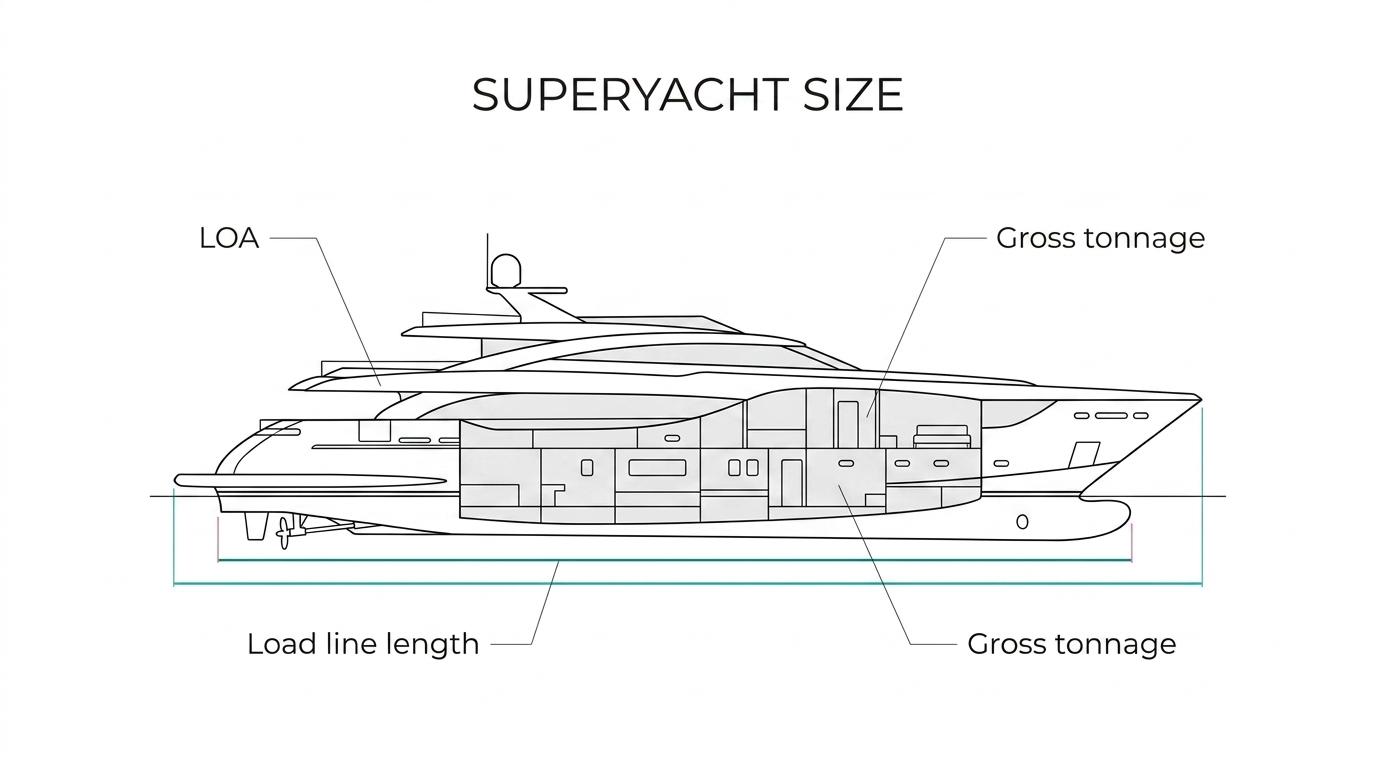
Then there is gross tonnage, often shortened to GT. This is not a weight figure in the normal sense. It is a measure related to the internal volume of the vessel. A yacht with high volume for its length may feel more substantial onboard than a slimmer yacht of similar LOA, and GT helps express that difference.
These are the three terms worth keeping straight:
- LOA: overall physical length used widely in brokerage, shipyard marketing and marina planning
- Load line length: regulatory measurement used in yacht codes and statutory compliance
- Gross tonnage: internal volume measurement that helps indicate scale and onboard space
A yacht’s status in conversation may be driven by LOA, while its compliance path may depend on load line length, and its sense of “size” onboard may be best reflected by GT. That is one reason the word superyacht stays flexible. It sits on top of several different technical measurements.
What makes a yacht function like a superyacht
Even when two yachts are the same length, only one may truly feel like a superyacht in practice.
The difference usually comes down to how the yacht is designed and operated. A superyacht is expected to support guest life at a high level, often with separate circulation for crew, dedicated service spaces, strong sound insulation, serious mechanical systems, tender and toy storage, and layouts that make time onboard feel easy rather than cramped.
Commercial use also matters. Many yachts above this size are built or managed with charter in mind, even if they also serve private use. That introduces another layer of standards around documentation, insurance, surveys, training, guest limits and operational procedures.
A superyacht, then, is not just “a big yacht”. It is a yacht designed for a more demanding style of ownership and operation.
UK yacht code rules for yachts over 24 metres
In the UK framework, the important reference point is the REG Yacht Code Part A, which applies to yachts in commercial use for sport or pleasure that are 24 metres in load line length and over, carry no cargo and no more than 12 passengers. This code replaced earlier large-yacht code arrangements, including the LY3 era, and remains a key benchmark in the sector.
That matters because many yachts in this bracket are not simple private pleasure craft in regulatory terms. If they are commercially operated, including charter use, they fall into a more structured compliance environment. Construction standards, equipment, surveys, crew matters and operational limits become more formal.
Older UK guidance also treated large commercial yachts as vessels of 24 metres and over in load line length, with certain historical references for older vessels by gross tonnage. The central point has stayed consistent: once a yacht crosses that large-yacht threshold, the rules change.
For owners and charter clients, the technical detail may stay behind the scenes. Yet it shapes everything from design decisions at build stage to where the yacht can trade and how it is crewed.
How buyers and charterers use the word superyacht
In practice, when a buyer or charterer asks about a superyacht, they are usually not asking for a legal definition. They are asking for a type of experience.
They expect a yacht of notable size, refined design, professional service and serious capability. That may mean a 24-metre motor yacht in the Mediterranean, a 35-metre charter yacht in the Caribbean, or a 70-metre custom vessel with global range. The label stretches, but the expectation stays recognisable.
That practical use of language is why the term has lasted. It is flexible enough to cover a broad fleet, yet precise enough to signal a clear step above ordinary yachting.
When accuracy matters, the clearest answer is simple: a superyacht is usually a luxury yacht starting at about 24 metres, often professionally crewed, with larger yachts then grouped informally into higher bands like megayachts and gigayachts.
And when the conversation turns to regulation in the UK, the key phrase is even more precise: 24 metres in load line length and over.